Ah, BlackRock! The financial colossus that dares to stop the floodgates of its $26 billion private credit fund. Yes, that’s right, the global titan has put a lock on the exit door, because apparently, there were too many withdrawal requests. Who would’ve thought? Investors actually wanted their money back. Shocking, really.
While this may sound like something only the “traditional” finance crowd has to worry about, this liquidity headache could have ripples that reach even the most glamorous of markets-Bitcoin and crypto. Oh, the drama!
BlackRock Caps Withdrawals as Redemption Requests Surge
The HPS Corporate Lending Fund, that lovable $26 billion behemoth, is the culprit here. According to the Financial Times, it had to slap some restrictions on withdrawals after investors requested about $1.2 billion-about 9.3% of the fund’s value. Now, mind you, the fund only lets investors withdraw 5% of the fund’s value per quarter. Oops. So BlackRock had to approve a measly $620 million, while the rest of the investors can twiddle their thumbs in a state of financial limbo.
Private credit funds like the HPS-essentially, corporate loans that no one buys or sells on the open market-rely on such “gates” to stop a full-on financial panic. After all, there’s no point in letting investors suck out cash if you’ve got nothing to back it up, right?
This little “incident” isn’t isolated. No, no. In fact, just recently, Blue Owl-another charming name in finance-had to adjust its redemption policies too, following a wave of withdrawal requests. Hmm, seems like the masses are getting nervous about their money. One might wonder why…
It’s not just BlackRock’s drama. Other funds have been dealing with rising redemption requests, all stemming from fears about the quality of credit and declining returns. It’s like watching a slow-motion car crash, but with more suits and ties.
In fact, Blackstone, a fellow player in the private credit space, had to process a record-breaking 7.9% withdrawal from its fund. That’s a lot of capital heading for the hills, isn’t it? But don’t worry-Blackstone did manage to fulfill all the requests. Because, of course, they could. So noble.
Blackstone is allowing investors to redeem a record 7.9% of shares from its flagship private credit fund, the latest sign of unease in an industry that’s faced a wave of withdrawals
– Bloomberg TV (@BloombergTV) March 3, 2026
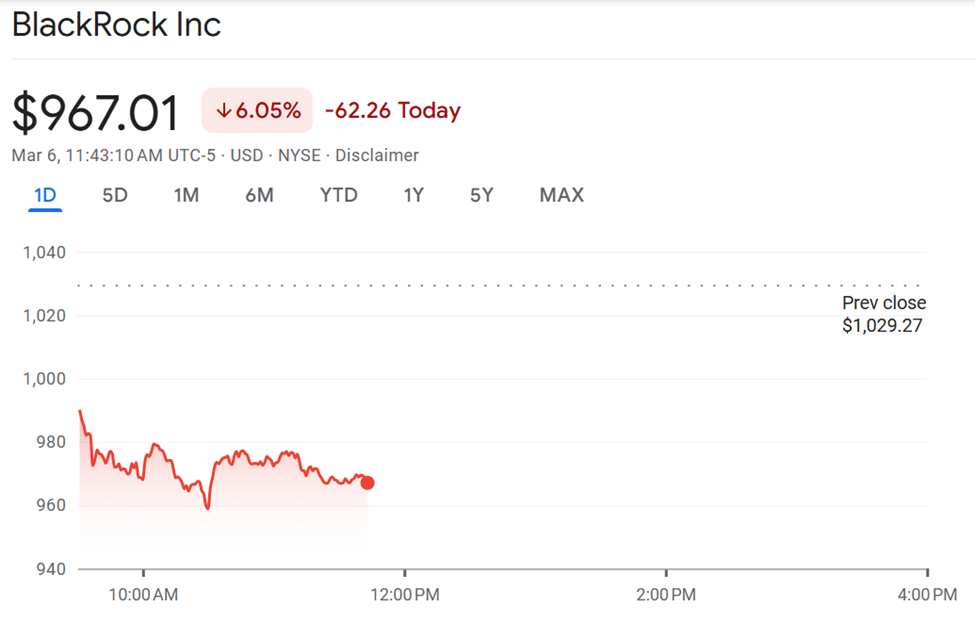
The news about BlackRock’s withdrawal cap made waves. Shares fell about 6% right after the news broke. Oh, the sweet sorrow of the stock market. Investors, no doubt, will be ringing their hands about this for days to come.
Liquidity Stress Could Spill into Crypto Markets
Now, you may ask, what does any of this have to do with Bitcoin and Ethereum? Well, when financial giants like BlackRock lock their doors, it creates a “liquidity crunch.” Meaning, investors who can’t access their private funds might just sell their shiny, “liquid” assets-like Bitcoin and Ethereum. Isn’t that convenient?
“When giants like BlackRock lock the gates on private funds, it signals a ‘liquidity crunch.’ Investors stuck in private credit might sell their ‘liquid’ assets-Bitcoin and ETH-to raise cash elsewhere,” wrote investor Paul Barron.
In simple terms, if people can’t access their funds from illiquid portfolios, they’ll probably look for something they can sell quickly. Guess what that is? Oh yes, you guessed it-cryptocurrencies like Bitcoin and Ethereum.
This isn’t new, folks. We’ve seen it before during times of financial stress when people were forced to sell whatever liquid assets they could find, be it stocks, gold, or good old crypto. The circle of life in finance!
But some folks-analysts, in this case-are starting to worry that this could signal something even bigger brewing in the financial markets. Because, you know, nothing says “everything is fine” like seeing major financial institutions sweating bullets.
“This is a major red flag. Something big is coming,” said market analyst Jacob Kinge.
A New Debate Between CeFi and DeFi
Beyond all the withdrawal drama, the whole situation has reignited an age-old debate: TradFi versus DeFi. That’s right, folks, the battle of the century. Or at least of the last few years. Paul Barron, ever the sage, pointed out that private credit funds are a perfect example of the risks of centralized finance-where investors are at the mercy of fund managers and their arbitrary “gates.”
“In private credit, you’re at the mercy of the fund manager’s ‘gate,’” he said. “In DeFi, the liquidity is mostly transparent and code-governed.”
Ah, DeFi-where liquidity is automated, visible to all, and governed by smart contracts. The beauty of decentralization. One might even call it the antithesis of all this “traditional” financial rigmarole.
Institutional Crypto Narrative May Strengthen
Despite the short-term fears that liquidity-driven selling might tank the market, there’s a silver lining. You see, all this mess in the traditional finance world could, in the long run, make a stronger case for blockchain-based financial infrastructure. Oh yes, indeed.
During times of liquidity crunches, people often start looking for alternatives. Alternatives that promise transparency, accessibility, and-most importantly-no locked doors. In this light, crypto could rise like a phoenix from the flames of traditional finance chaos.
But let’s not get ahead of ourselves. For now, we are still dealing with the fact that even a simple withdrawal cap in a private credit fund can have cascading effects across global markets. Welcome to the interconnected world of finance, where everything is linked, and nothing is as it seems.
Read More
- Brent Oil Forecast
- Gold Rate Forecast
- USD PHP PREDICTION
- Solana Co-Founder Calls North Korean Hack ‘Terrifying’ – Here’s How They Did It
- 🤑 Bitcoin, Bills, and Bold Moves: Lummis’s Crypto Revolution! 🌟
- Szabo’s Bitcoin Warning: Don’t Mess It Up!
- Why Bitcoin is the New Water Cooler Topic: Decline, Drama, and Structural Weakness!
- U.S. Treasury Wants Your Wild Ideas for Crypto Shenanigans Detection🤑
- Trump’s Fed Fiasco: Judge Saves Cook from the Orange Flame🔥
- The Surprising Altcoins Poised for Glory Just Before the Fed’s Big Decision!😲
2026-03-06 20:35