Cryptocurrency exchanges, once modest digital bazaars where one could buy a coin or two, now resemble bustling fairs where the serious folk of traditional finance wander in, squinting at screens as if they had stumbled into a theater of the absurd. According to the latest CryptoQuant report, these platforms are no longer merely for crypto enthusiasts-they are now impromptu stages for the old-money crowd to perform financial acrobatics beyond the usual tokens.
The most conspicuous sign of this transformation is the meteoric rise of perpetual futures on conventional assets. Imagine a perpetual motion machine of trading, where commodities, equities, and macro assets twirl endlessly, unbothered by office hours or lunch breaks. Unlike conventional markets, which politely close their gates at five, crypto exchanges keep the lights on, as if mocking the concept of “business hours” with a sly grin.
During recent surges in gold and silver prices, these exchanges resembled a village suddenly flooded with eager visitors. Traders, unable to contain their excitement, flocked to crypto platforms to chase these perpetual contracts. Here, timing is everything, and waiting for traditional markets would be akin to waiting for a postman in a snowstorm-pointless and irritating.
CryptoQuant notes that this isn’t a passing fancy; it signals a structural shift. The line between the old guard of finance and the new playground of digital assets is blurring. Exchanges are becoming hybrids-part crypto carnival, part traditional financial institution-where both worlds coexist with a bemused nod to each other.
TradFi Perpetual Futures Flourish Like Dandelions
Consider Binance, whose TradFi perpetual futures now boast a cumulative trading volume surpassing $130 billion and over 90 million trades-a number so dizzying one might wonder if anyone actually sleeps. Within two months, February 24 saw total volume cross $100 billion, a feat that would leave even seasoned bankers gasping for breath.

These contracts allow for the trading of everything from gold to palladium, platinum, and a veritable alphabet soup of stocks: AMZN, COIN, CIRCL, HOOD, INTC, MSTR, PLTR, TSLA. The effect is akin to sipping fine tea in a madhouse-you get all the sophistication without the tiresome constraints of daylight or stock exchange etiquette.
Predictably, gold and silver dominate. On March 3, daily volumes reached $3.77 billion and $3.75 billion, respectively. The frenzy escalates during price surges-January 30, 2025, witnessed gold and silver trading at record highs, $4 billion and $7 billion in daily volume, a spectacle that might have made even Chekhov’s most patient character blush.
Participation numbers reinforce the absurdity: roughly 4.4 million trades per day, gold alone claiming 2 million, silver nearly 1.9 million. A modern ballet of clicks and figures, performed with relentless devotion.
Crypto Market Cap Juggles the Tightrope After Correction
The total cryptocurrency market cap has stumbled to around $2.37 trillion after a dizzying climb to nearly $4 trillion. The chart depicts a scene of delicate balance, as if the market itself were a nervous playwright pacing the stage, unsure whether to applaud or faint.
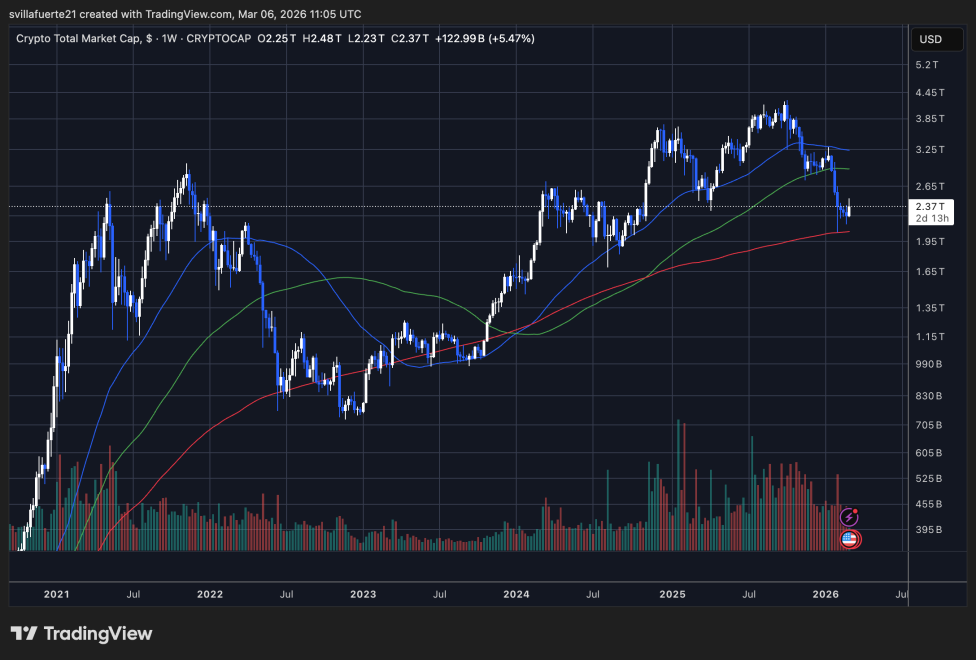
Recent declines nudged the market below the 50-week moving average, a level that once dutifully supported it like a loyal stagehand. Support clusters, those invisible props of $2.3 trillion, $2.1 trillion, and $2 trillion, now attempt to stabilize this dramatic act.
Though the current correction is awkward and inconvenient, it is but a minor intermission in a longer, upward narrative that began in early 2023. Should the market manage to hold above $2.3 trillion, the performance may resume with vigor, possibly challenging resistance in the $2.8-$3 trillion range-a finale that promises applause, or at least wry smiles.
Read More
- Brent Oil Forecast
- Gold Rate Forecast
- Why Bitcoin is the New Water Cooler Topic: Decline, Drama, and Structural Weakness!
- Szabo’s Bitcoin Warning: Don’t Mess It Up!
- How the SEC and Nasdaq Play Whack-a-Mole with Chinese IPO Scandals 🎭💼
- USD PHP PREDICTION
- Polygon’s T-REX: Can This Tech Outsmart Wall Street’s Chaos?
- XRP: The Crypto That’s More Lost Than a Hitchhiker Without a Towel
- Avalanche’s Grand Waltz: Blockdaemon’s Staking Soiree for the Suits
- Short Sellers Got Nuked: XRP Liquidation Skyrockets 1,278%
2026-03-07 10:12