Delaware is considering a new law, Senate Bill 19, to oversee companies that issue stablecoins. This law would place these companies under existing state banking rules and aim to make Delaware a leading regulator for stablecoins under a new federal law, the GENIUS Act, which takes effect in July 2025.
Following discussions with Delaware’s financial industry, Spiros Mantzavinos and Representative Bill Bush have created a new law to formally license companies issuing payment stablecoins below a $10 billion limit – a threshold already set by federal law. This law is significant because it shows how states can regulate digital currencies, potentially even taking the lead instead of relying solely on federal oversight.
The timing of this legislation is deliberate. Because the GENIUS Act requires states to have rules in place by July 18, 2026, to qualify for certification, Delaware has a limited time – about four months after this bill’s introduction – to create a plan that will meet federal standards. Senate Bill 19 is designed to be that plan.
🚨NEW: DELAWARE BILL MANDATES 1:1 RESERVES FOR STABLECOIN ISSUERS
Delaware has passed a new law to oversee stablecoins. This law requires companies that issue stablecoins to follow state banking rules.
The proposed law requires full reserve backing. Each issued stablecoin must be matched…
— BSCN (@BSCNews) March 24, 2026
EXPLORE: Hyperliquid Opens US Policy Advocacy Center
SB 19’s Mechanics: Licensing, Reserves, and the Federal Certification Threshold
If Senate Bill 19 passes, companies issuing stablecoins and wanting to operate in Delaware would need a license. This license would be issued by the state’s Office of the State Bank Commissioner, the same agency that already oversees state-chartered banks and trust companies.
This legislation uses the same definitions for payment stablecoins as the GENIUS Act – these are digital currencies designed to hold a stable value and be used for payments. It also requires companies that issue these stablecoins to hold enough high-quality, easily-sellable assets to fully back every token in circulation.
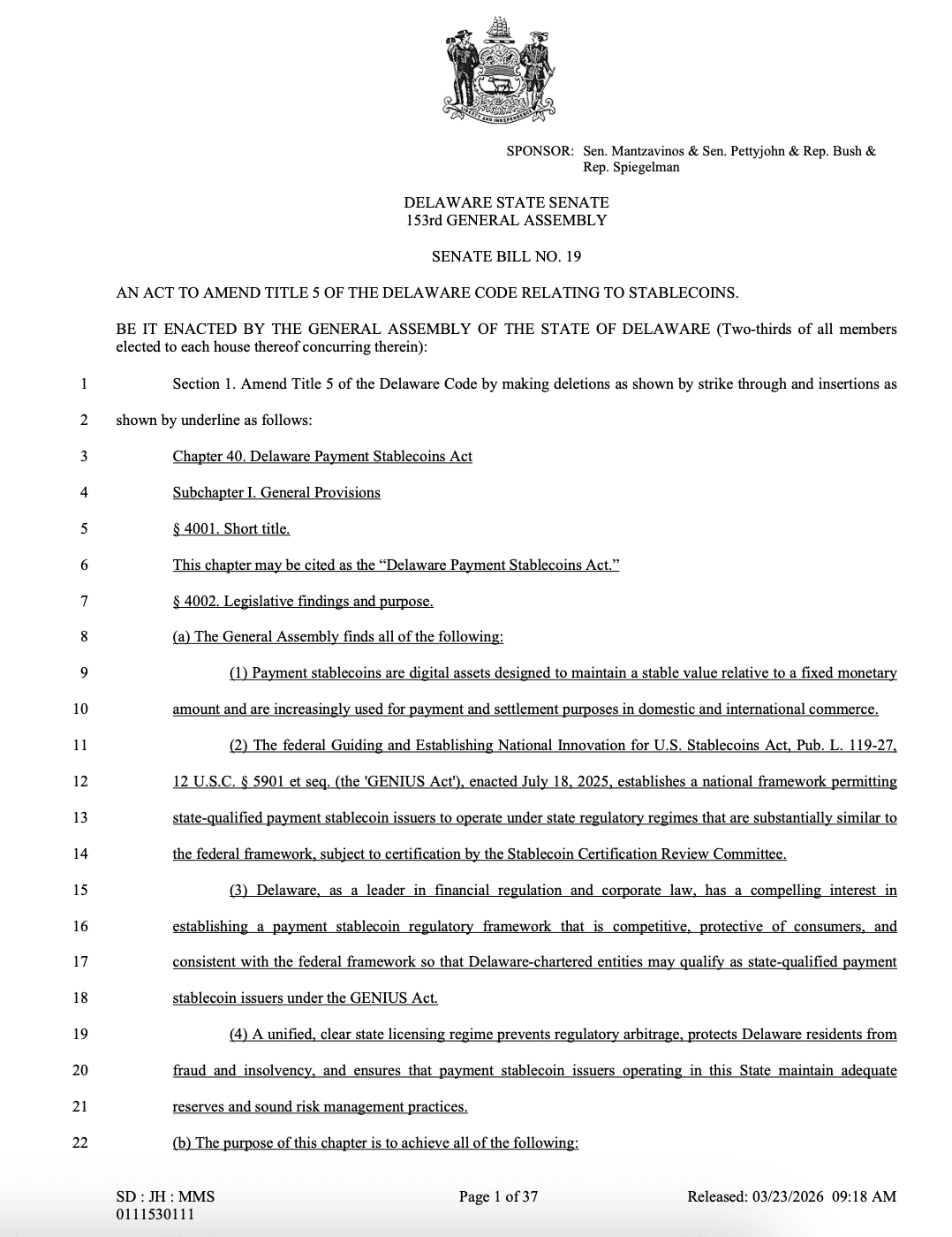
(Source: Delware Legal)
A key part of the GENIUS Act is a $10 billion limit. If a stablecoin issuer has less than $10 billion outstanding, it can follow the rules of a qualifying state instead of being directly overseen by the federal government. However, this is only allowed if the Stablecoin Certification Review Committee – a group from the Treasury Department, Federal Reserve, and FDIC – confirms that the state’s rules are very similar to federal standards within 30 days of review.
Delaware seems to have intentionally adopted the definitions from the GENIUS Act to make the certification process easier. Companies that grow beyond $10 billion in issuance will need to switch to federal oversight within a year, or stop issuing new securities. However, states with a strong history of supervision may be able to request a waiver.
Issuer Implications: What Delaware Stablecoin Compliance Actually Requires
The requirements of SB 19 are very similar to, and in some ways copy, the rules already in place in New York State through the Department of Financial Services (NYDFS) BitLicense. Since 2015, the BitLicense has required companies like Circle and Paxos to regularly prove they have enough reserves, undergo independent audits, and get approval before making significant changes to their businesses.
If approved, Delaware’s proposed system wouldn’t mean less regulation, but rather a different way to meet the same standards. Companies already regulated by New York’s financial regulator would have to comply with two sets of rules if they also seek certification in Delaware, which experts predict will lead to efforts to simplify the process.
Delaware has officially introduced the Delaware Payment Stablecoins Act (SB 19).
A new bill proposed by Senators Mantzavinos and Pettyjohn would create a strict licensing system for companies issuing financial products at the state level.
Delaware is positioning itself to be the “Gold Standard”…
— Conor Kenny (@conorfkenny) March 24, 2026
As an analyst, I’ve found that the rules around the GENIUS Act really limit what Delaware can do with its assets. Specifically, the Act requires that only super-safe, short-term investments – like U.S. Treasury securities and central bank reserves – can be used as collateral. This makes it difficult for Delaware to stand out or offer unique investment options.
States can differentiate themselves through how often they conduct examinations, the fees they charge for licenses, and how quickly their smaller administrative teams respond to questions from the industry. It’s still unclear whether this flexibility and speed are more valuable to businesses than the well-known reputation of being overseen by the New York Department of Financial Services, and issuers will ultimately decide this by where they choose to incorporate.
Federal Alignment and the Interstate Regulatory Picture
Delaware’s new rules for stablecoins come as the U.S. is still developing a complete set of regulations for them. While a federal law, the GENIUS Act, sets the main rules, Delaware’s system needs to meet certain standards – specifically, standards around what constitutes a ‘similar’ stablecoin. The details of those standards are expected from federal regulators by January 18, 2026.
The decision will show if states truly have the freedom to create their own rules for overseeing digital assets, or if they’ll essentially have to follow federal regulations exactly. Other states, like Texas and Wyoming, that are also working on digital asset laws are paying close attention to Delaware’s application; if Delaware succeeds, it will support the idea of states and the federal government each having their own rules, and likely encourage more states to create similar laws.
While the GENIUS Act reduces the chance of federal law overriding state rules for money transmission, it doesn’t remove the risk entirely. If Congress changes the law or the Secure and Reliable Cashing Regulation (SCRC) sets requirements Delaware can’t meet without changing its own laws, companies in Delaware would quickly have to move back under federal oversight.
🇺🇸“We’re not the securities and everything commission anymore”
As an analyst, I’m following the SEC’s recent move to clarify how existing federal securities laws apply to digital assets. They’ve done this by referencing definitions established in the GENIUS Act, which helps provide a framework for understanding these new technologies within the current legal structure.
The document clarifies bitcoin and other digital assets as a…
— The Rage (@theragetech) March 18, 2026
The next key step is the SCRC’s review to certify the new rules. This review must be completed within 30 days after Delaware officially submits them, but it can’t begin until the new law (SB 19) is passed and the Commissioner publishes the final details. Companies and their lawyers should pay attention to federal guidance, which is expected by January 18, 2026. This guidance will set a minimum standard that Delaware’s rules must meet to be considered acceptable.
If approved as planned, Delaware is poised to become the first state besides New York to provide a clear regulatory path for stablecoins approved by federal authorities. This would significantly change how digital currencies are issued before the new GENIUS Act takes effect in July 2026.
Read More
- USD CNY PREDICTION
- FIL PREDICTION. FIL cryptocurrency
- Silver Rate Forecast
- CNY JPY PREDICTION
- JPY KRW PREDICTION
- Gold Rate Forecast
- USD VND PREDICTION
- CNY RUB PREDICTION
- SOL PREDICTION. SOL cryptocurrency
- Brent Oil Forecast
2026-03-24 17:25