
What to know:
Stay informed with Crypto Long & Short, our weekly newsletter designed for serious investors like you. We deliver insights, news, and analysis directly to your inbox every Wednesday – sign up here to receive it!
Welcome to our institutional newsletter, Crypto Long & Short. This week:
- Ryan Kirkley on how crypto prediction markets can risk incentivizing manipulation and amplify misinformation at scale.
- Top headlines institutions should pay attention to by Francisco Rodrigues.
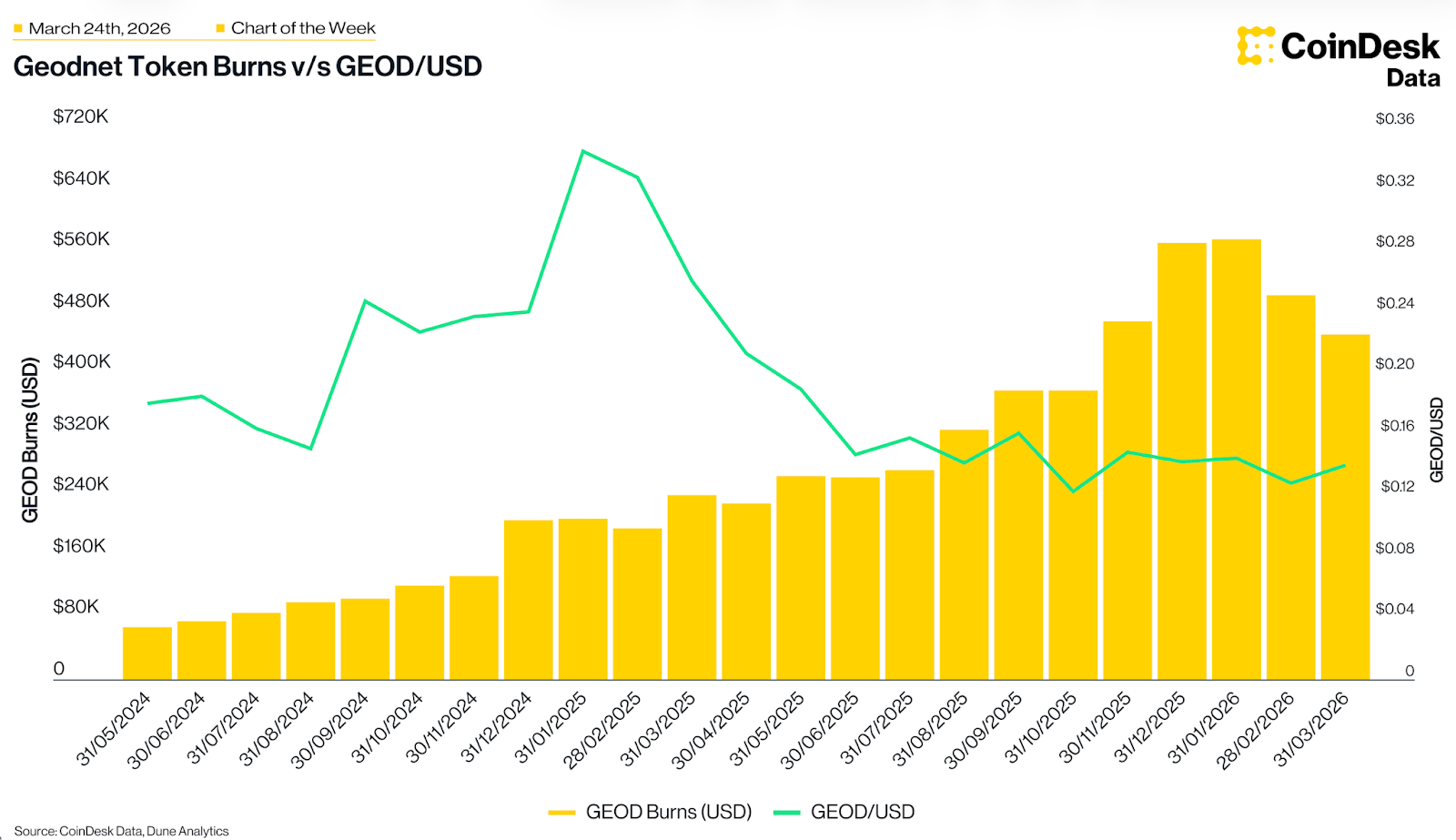
- Geodnet decoupling suggests fundamental re-rating in Chart of the Week.
Thanks for joining us!
-Alexandra Levis
Expert Insights
Prediction Markets Don’t Just Forecast Power – They Reshape It
By Ryan Kirkley, Co-Founder and CEO of Global Settlement Network
Prediction markets are frequently presented as objective forecasting tools – a way to combine everyone’s knowledge and turn it into a price that reflects what people believe. This isn’t entirely inaccurate; research shows these markets can often make better predictions than traditional methods. However, as someone interested in how crypto can improve market systems, I think it’s important to be upfront about what’s happening now. The current crypto-based prediction markets aren’t simply about predicting the future; they’re increasingly about turning real-world uncertainty into financial opportunities.
This difference is important. Platforms like Polymarket allow users to bring funds from various blockchains – Ethereum, Solana, Bitcoin, and others – and convert them into a stablecoin (USDC.e) on the Polygon network. This enables trading and settling of yes/no predictions directly on the blockchain as digital claims. Essentially, cryptocurrency isn’t just a platform for these markets; it expands their reach globally, allows funding from multiple blockchains, and makes transactions much smoother. This is a well-designed market, and it’s also why the potential risks are greater.
Turning events like war, political unrest, or societal collapse into tradable cryptocurrencies creates opportunities for malicious actors. It’s easy to see how someone with inside knowledge could profit from it. U.S. financial regulators have always understood that not every event should be bought and sold on the market. For example, regulations currently prevent trading contracts based on things like terrorism, assassination, and war, because these are considered harmful to the public good. This isn’t about opposing markets; it’s acknowledging that certain contracts can actually change how people behave surrounding the event itself, not just reflect information about it.
A more concerning issue is that prediction markets can actually *reward* people not just for knowing what will happen, but for actively trying to *make* something happen. Research shows that if traders have personal reasons to influence an event, or can take actions to change the outcome, the market’s ability to accurately gather information can fail. Ideally, a market should simply reflect the likelihood of an event. However, when the market creates incentives, it can start to change the very probabilities it’s trying to measure.
This isn’t just a hypothetical worry anymore. Recent reports from Reuters show that trading activity surrounding potential Iranian strikes and the removal of Ayatollah Khamenei raised concerns about ethics and illegal insider trading, as some bets appeared unusually well-timed. Additionally, Polymarket took down bets related to a nuclear explosion following public criticism. Even if only a few traders are using confidential information, it sends a damaging message: being connected, rather than having good judgment, seems to be what leads to success.
A third danger is unique to these crypto platforms: they’re becoming as much about spreading information as they are about trading. As Axios reported, accounts on these platforms were recently sharing inaccurate, misleading, or incomplete information with millions of people on social media, turning market predictions into popular stories *before* the facts were known. This means that those trying to manipulate events don’t even need to affect the events themselves – they can simply control the narrative around them by spreading false information.
Financial professionals often mistakenly assume that any market with publicly available prices is a sound investment. While cryptocurrency has the potential to improve financial systems by speeding up transactions, increasing transparency, and enabling more flexible financial tools, simply creating faster ways to bet on negative events like wars or political crises isn’t true innovation. It’s actually creating a dangerous situation on a massive scale. Current cryptocurrency-based prediction markets don’t just predict what will happen; they actively encourage and reward those who profit from instability and chaos.
Headlines of the Week
Francisco Rodrigues
Despite positive developments in regulations this week, the crypto market is facing increased worry and challenges due to both general market concerns and the rapid changes brought about by artificial intelligence.
- SEC approves Nasdaq’s move to support tokenized securities trading: The U.S. Securities and Exchange Commission (SEC) has approved Nasdaq’s plan to let certain securities trade in tokenized form after the firm filed for regulatory permission in September.
- Senators say they’ve reached compromise on yield to advance crypto market bill: Potentially clearing a path for the crypto Clarity Act to be approved, two key senators have said they have agreed on a compromise that could advance the bill to its next stage.
- U.S. SEC issues first-ever definitions for what crypto assets are securities: The guidance doesn’t yet carry the weight of a formal new rule, and was issued in partnership with the Commodity Futures Trading Commission.
- Bitcoin options signal extreme fear as downside protection premium hits new all-time high, says VanEck: Traders are paying record prices for downside protection, with the put/call open interest ratio reaching its highest level since June 2021 and put premiums hitting a new record relative to spot volume.
- Crypto.com cuts 12% of staff as it integrates AI across the business for efficiency: While Crypto.com’s layoffs were the largest in the crypto space over the past week, the Algorand Foundation also cut 25% of staff. Last week, OP Labs laid off 20 employees to narrow its focus, while the team behind Story Protocol let go 10% of its workforce.
Chart of the Week
Geodnet decoupling suggests potential fundamental re-rerating
Geodnet, a network providing precise location data for robots and AI, is showing a disconnect between its price and its underlying strength. Although its price hasn’t moved much recently, and is slightly underperforming other similar projects, it’s been burning a significant amount of its own tokens – around $500,000 worth each month. This burn rate is currently offsetting 60-80% of new tokens created. This difference is happening because Geodnet is earning more revenue from companies building self-flying drones and humanoid robots. As Geodnet shifts its focus from simply building the network to selling valuable location data for these machines, the current situation – where demand is higher than supply – could lead to a significant increase in its value.
If you’d like to stay informed, I recommend checking out CoinDesk for the newest cryptocurrency news at coindesk.com. They also have dedicated market updates specifically for institutional investors at coindesk.com/institutions – a great resource I often use in my research.
Read More
- USD CNY PREDICTION
- FIL PREDICTION. FIL cryptocurrency
- JPY KRW PREDICTION
- Silver Rate Forecast
- CNY JPY PREDICTION
- SOL PREDICTION. SOL cryptocurrency
- Gold Rate Forecast
- USD VND PREDICTION
- USD RUB PREDICTION
- EUR USD PREDICTION
2026-03-25 21:46