As a researcher following market trends, I observed a significant sell-off in U.S. markets yesterday. The increasing tensions between the U.S. and Iran really seemed to drive this, causing oil prices to jump. Investors reacted by moving away from stocks, cryptocurrencies, and surprisingly, even gold – typically a safe haven in times of uncertainty.
Wall Street Loses $1 Trillion in Single Session
The Dow Jones Industrial Average fell 1.01% to close at 45,960.11. The S&P 500 dropped 1.74% to 6,477.16. The Nasdaq Composite led the decline, shedding 2.38% to close at 21,408.08. All three indices reversed gains posted Wednesday, when the Dow gained 0.66%, the S&P 500 rose 0.54%, and the Nasdaq added 0.77%.
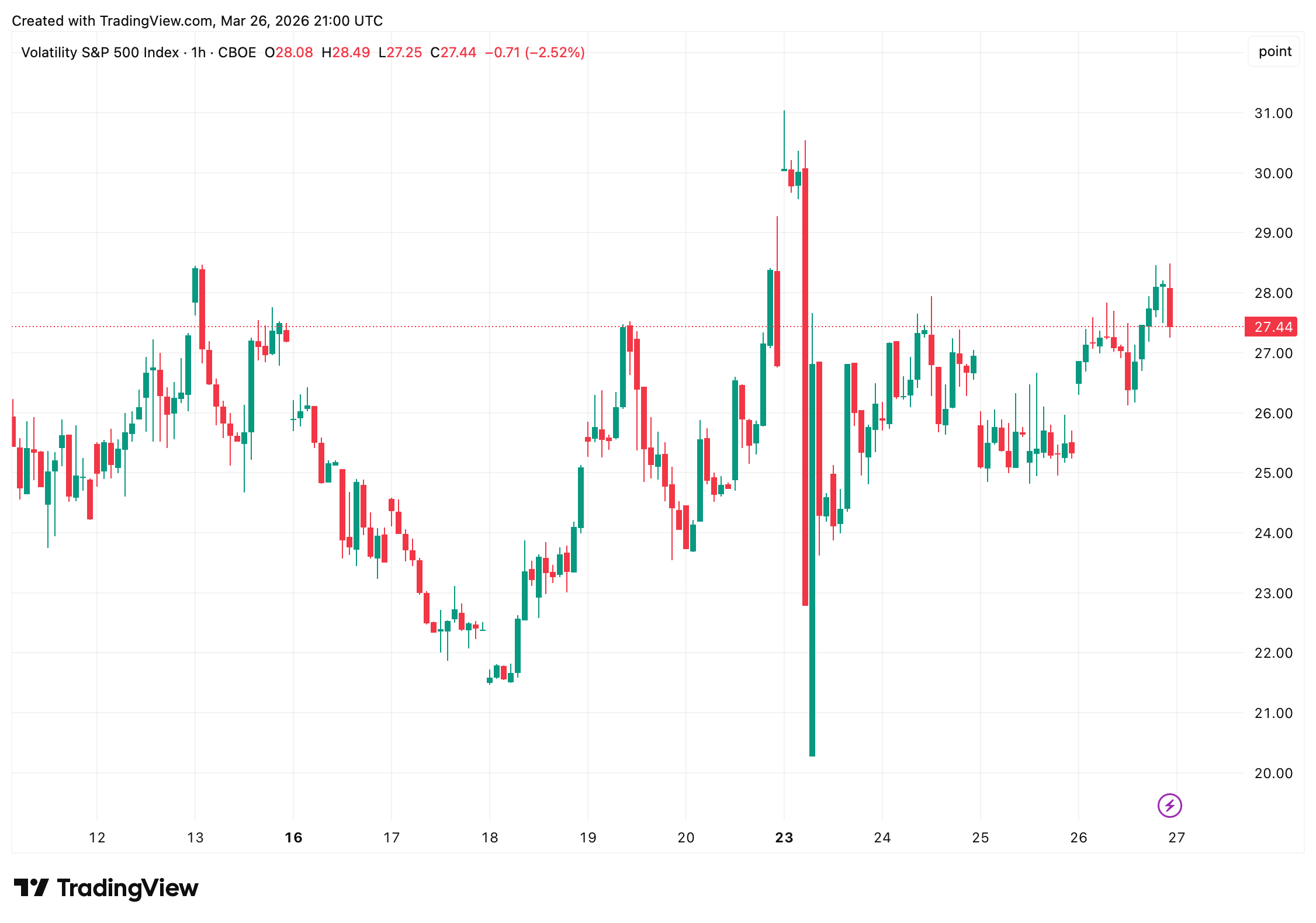
The CBOE Volatility Index, widely tracked as Wall Street’s fear gauge, climbed to 27.44 — a level that signals traders are pricing in further turbulence.
West Texas Intermediate (WTI) crude oil jumped 2.2% to approximately $92.16 per barrel. The move reflects market concern over potential supply disruptions tied to the U.S.-Iran conflict now entering its fifth week. Brent crude is back at the $100 line, up 2.8% during today’s trading session.
Negative headlines around Google’s artificial intelligence (AI) operations added to selling pressure in the tech and semiconductor sectors. Treasury yields moved higher across the curve. The 2-year yield rose to 3.96%, the 10-year climbed to 4.42%, and the 30-year reached 4.93%.
Yields rising in tandem with equity losses suggest investors are pricing in inflation and energy-linked growth risks rather than seeking safety in government bonds. Gold fell approximately 3% to around $4,392 per ounce. Silver dropped between 4% and 6% to approximately $68.35 per ounce. Both metals sold off despite the geopolitical backdrop — a move analysts attributed to profit-taking and a stronger U.S. dollar.
Market data shows that bitcoin declined roughly 2.5% to approximately $68,842 by 5 p.m. Eastern time. Ethereum fell 4.4% to around $2,066. Broader crypto markets followed equities lower, with most altcoins posting losses and no major positive catalysts in sight.
Analyst: Europe’s Debt Bomb Is Getting Harder to Ignore
Sergei Gorev, head of risk at Youhodler, said bitcoin’s relative stability reflects demand that has kept the asset from deeper losses even as traditional markets sink. “ Bitcoin has been consolidating for a month and a half,” Gorev told TopMob. “While the S&P 500, gold, and global debt markets continue to set new local price lows.”
Gorev highlighted growing concerns in European government debt markets. He noted that interest rates on long-term bonds in France and Germany have reached 15-year highs. With already high debt levels, large budget deficits, and a significant portion of government spending going towards paying off debt, these rising rates pose a serious risk to those countries.
The analyst draws a direct line between Middle Eastern capital flight and bitcoin‘s bid. “We believe that the money of private investors seeking to escape the ‘Arabian tale in the desert’ supports the price of BTC,” Gorev explained. “Many elites buy at current prices and withdraw their capital from banks in the form of cryptocurrencies, bypassing controlled banking systems.”
Gorev said that the dynamic has shifted net spot demand for bitcoin into positive territory. “More BTC is being bought on the market than miners are mining,” he said. “The current price consolidation is a phase of cryptocurrency accumulation by investors from the Middle East.”
The broader picture, according to Gorev, is that bitcoin is caught between two forces pulling in opposite directions. Spot exchange-traded fund (ETF) inflows are providing a floor. European debt stress and rising oil prices are applying pressure. “This may continue in the medium term and keep the prices of cryptocurrencies from falling, along with the European debt market diving down,” he added.
FAQ 🔎
- What caused U.S. stocks to fall on March 26, 2026? Escalating U.S.-Iran tensions drove oil prices higher, pushed the VIX to 27.44, and triggered broad selling in equities, tech, and crypto.
- Why did Bitcoin hold up better than stocks and gold during Thursday’s selloff? Analysts say spot ETF inflows and capital leaving Persian Gulf countries via crypto purchases helped support Bitcoin’s price near $69,000.
- Why did gold fall during a geopolitical risk event? Gold dropped roughly 3% despite Middle East tensions, likely due to profit-taking and U.S. dollar strength outweighing typical safe-haven demand.
- What does rising European bond yield data mean for global markets? French and German 10-year yields hitting 15-year highs signal growing debt stress that analysts warn could escalate into a pan-European fiscal crisis.
Read More
- Brent Oil Forecast
- Silver Rate Forecast
- HYPE PREDICTION. HYPE cryptocurrency
- Gold Rate Forecast
- USD CNY PREDICTION
- CNY JPY PREDICTION
- ETH PREDICTION. ETH cryptocurrency
- USD VND PREDICTION
- CNY RUB PREDICTION
- FIL PREDICTION. FIL cryptocurrency
2026-03-27 00:59