In the long corridor of modern finance, Tuesday delivered another page of the absurd: Arbitrum’s Security Council, that ceremonial gatekeeper of code and caution, froze seventy-one million dollars of stolen funds. The attacker-a nameless silhouette in the digital fog-answered with a speed that would shame any clerk counting beans in a bunker of spreadsheets.
The misfortune began when a nameless desperado found a crack in Kelp DAO’s LayerZero-powered bridge, and carried off 116,500 rsETH-about $292 million and nearly 18% of the token’s circulating life. An emergency pause of Kelp DAO’s core contracts rattled the cages, but the malice had already stamped its passport and departed the station.
The stolen rsETH was then posted as collateral on Aave V3, where it was used to borrow roughly $196 million in wrapped ether, leaving Aave to wear bad debt it did not deserve and did not conjure. A ledger of consequences, printed in the margins of a digital temple built on trust and a prayer that the numbers would behave.
Arbitrum’s Security Council acted, freezing 30,766 ETH-worth about $71 million at the moment-and moving the funds into a governance-controlled wallet. It was a decisive gesture, swift by the feverish pace of blockchain time, a slap of order in a chaos of code and greed.
The attacker did not linger to see what would come next. Within hours, the thief began reacting-an unmistakable sign that the funds had already slipped into the vast current, and that the window for any on-chain rescue might be narrowing with each breath the network takes.
$175 Million Is Already Moving – and the Debate It Leaves Behind Is Just Beginning
Arkham data confirms the dread many whispered once Arbitrum acted. The Kelp DAO hacker has already moved all 75,701 ETH-about $175 million-on Ethereum and has begun laundering the loot. The Arbitrum freeze captured $71 million; the rest, by a margin that mocks arithmetic, is in motion and being carefully hidden behind the fog of addresses and nonce-sequences.

The math is stark. A coordinated intervention by one of DeFi’s most able security councils froze less than a third of the stolen treasure. The rest slipped away, as if through a security checkpoint with no guards and no doors.
That escape has sparked a debate wider than Kelp DAO and Aave. Arbitrum’s ability to freeze wallet addresses-even in the wake of a theft-has provoked immediate questions about what blockchain immutability truly means in practice, and who carries the power to override it. For some, the freeze is responsible crisis management in a maturing ecosystem defending its users. For others, it is precisely the centralized blade in the decentralized environment that it pretends to distrust.
Both sides speak loudly, and both judgments are tinted with truth and misgiving.
What is not in dispute is the damage this attack has inflicted on DeFi’s credibility at a moment when the building is most fragile. The Kelp DAO exploit revealed collateral risk in lending protocols, triggered an $8.45 billion exodus of deposits from Aave, sent AAVE down nearly 20%, and has now provoked a philosophical confrontation about the limits of decentralization at the worst possible hour-the hour when the public most needs to believe in the system’s steadiness.
rsETH Market Cap Reflects Instability in Kelp DAO’s Restaking Layer
The market cap of rsETH-the liquid restaking token issued by Kelp DAO-hovers near $1.3 billion after a brutal contraction that unsettled its prior recovery. The chart once showed peaks above $2 billion; now it dances in a volatile, downward arc, a mirror of stress within the restaking ether rather than a natural market rhythm.
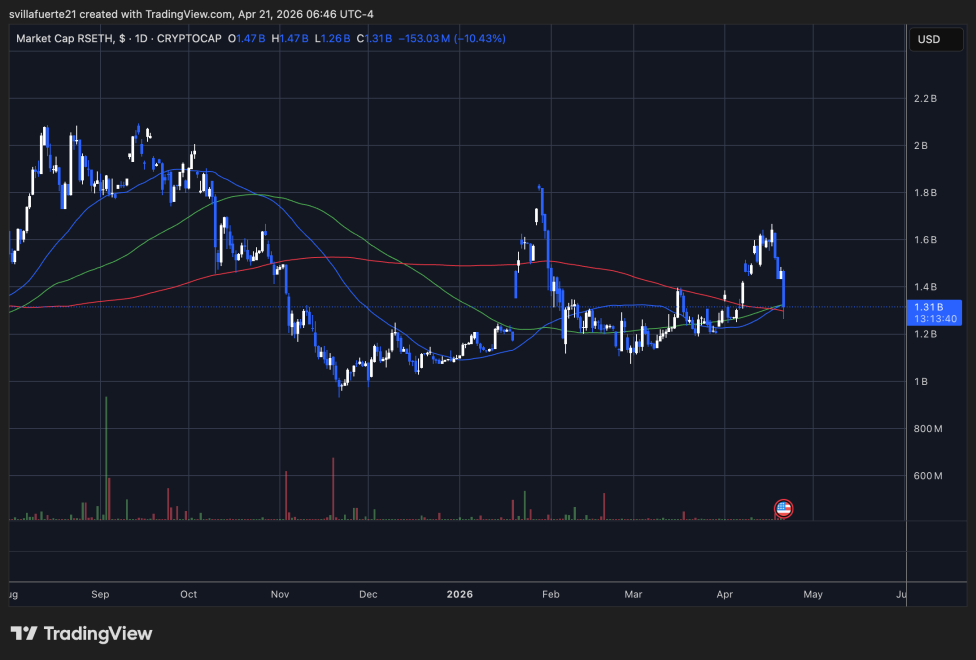
The latest move is particularly telling. After a brief rise toward the $1.6 billion region, the market cap was rejected and fell sharply back toward the $1.3 billion level. Such rapid surges followed by equal misfortune typically signal forced unwind rather than any genuine flood of capital. In this frame, that behavior aligns with the exploit-an act that injected systemic uncertainty into a restaking asset that should have known better than to trust in shadows.
From a structural view, rsETH now trades below its key moving averages, with the 200-day trend flattening and beginning to bend downward. That signals a stall in the growth phase that once defined its ascent, at least for the present.
Because rsETH stands as collateral within broader DeFi systems-including lending protocols-its market cap is not merely a valuation metric, but a stand-in for trust. The current compression speaks plainly: confidence has weakened, and until stability returns, the restaking layer remains vulnerable to further storms.
Read More
- Brent Oil Forecast
- Silver Rate Forecast
- ATOM PREDICTION. ATOM cryptocurrency
- Bitcoin & Ethereum ETF Outflows Make Investors Cry, Again
- XRP: A Bounce or a Booby Trap? CasiTrades Says Mind the Gap!
- Gold Rate Forecast
- Why Bitcoin is the New Water Cooler Topic: Decline, Drama, and Structural Weakness!
- Dogecoin ETF Smashes Expectations! 🚀
- 🤑 Bitcoin, Bills, and Bold Moves: Lummis’s Crypto Revolution! 🌟
- Bitcoin’s Dance with Destiny: Will It Rise or Fall into the Abyss?
2026-04-22 04:56