
What to know:
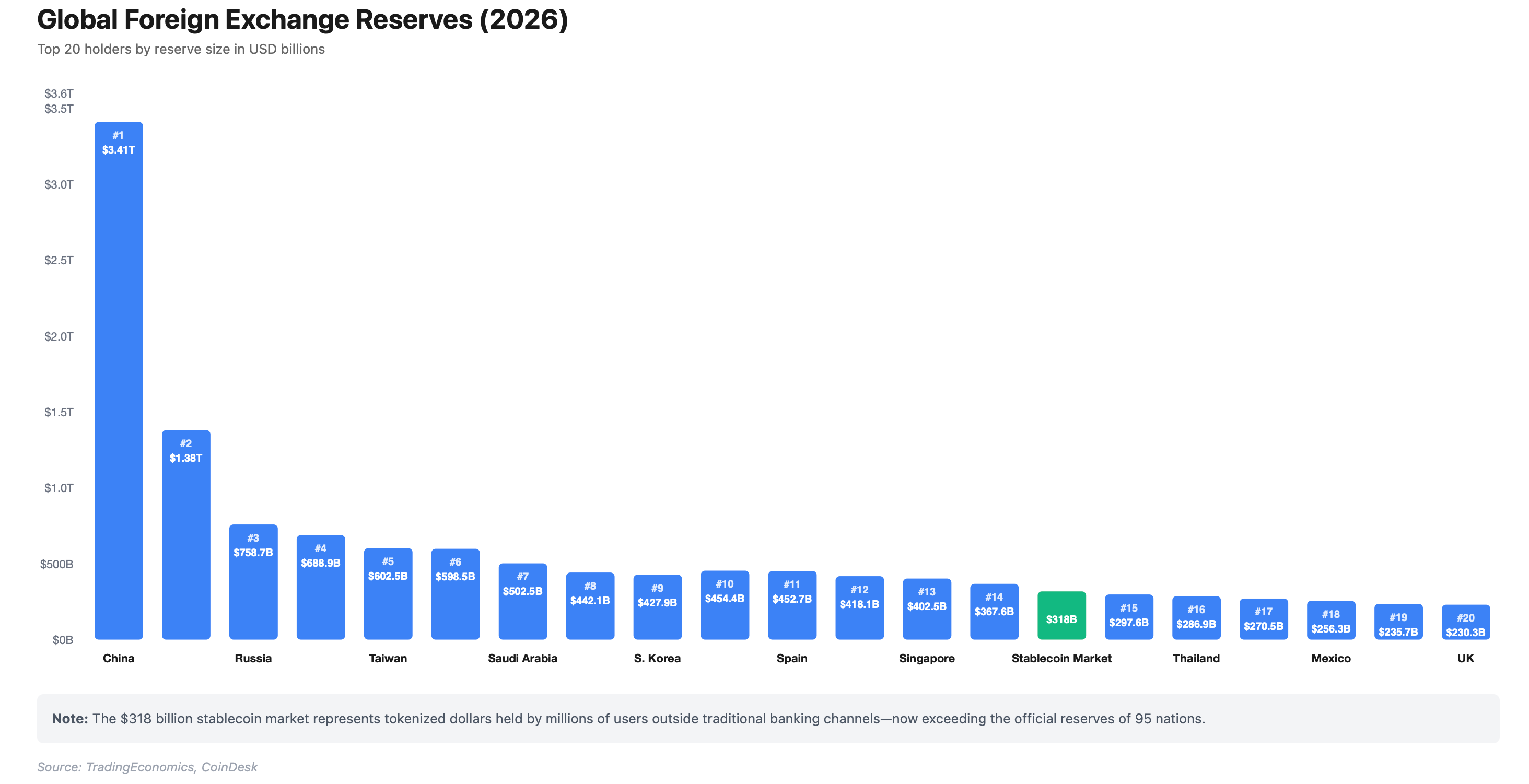
- The total market value of stablecoins has reached a record $322 billion, surpassing the foreign exchange reserves of 95 countries, including developed economies like the United Kingdom and Canada.
- The data underscores how quickly capital is shifting to digital rails.
- While stablecoins are increasingly used for trading, DeFi and cross-border payments, global regulators warn they can accelerate capital flight and currency depreciation in emerging markets.
Stablecoins now have a total value of $322 billion – a new record. This is more than the foreign exchange reserves held by 95 countries, even some wealthy, developed ones.
Currently, the total value of these companies exceeds the foreign exchange reserves of countries like Poland, Thailand, and Mexico, as well as developed nations including the United Kingdom, Canada, and the United Arab Emirates.
Currently, people hold more dollars and other government-issued currencies outside of banks than most countries hold as official reserves to protect against economic crises.
Stablecoins are digital currencies built on blockchain technology that aim to hold a steady value. They’re designed to mirror the price of traditional currencies like the U.S. dollar, euro, or yen, usually at a 1-to-1 ratio. Over the past few years, the total value of all stablecoins has increased dramatically, and most of this activity involves coins tied to the U.S. dollar, like Tether and USD Coin (USDC).
The growth is evidence of how fast capital is migrating to blockchain rails.
Foreign exchange reserves are the money and gold that countries’ central banks keep on hand. They use these reserves to keep their currency values stable, pay off debts to other countries, and fund important imports like energy. Currently, only 14 countries – including China, Japan, Russia, India, Taiwan, and Germany – have more of these reserves than the total value of all stablecoins.
Double-edged sword
Stablecoins are popular for buying and selling cryptocurrencies. They let people quickly move out of rapidly changing digital currencies without needing to convert back to traditional money like dollars or euros. In the world of decentralized finance (DeFi), they act as a foundation for transactions, and they offer a quicker, less expensive way to send money internationally, avoiding traditional banks.
A new report from the Bank of International Settlements shows that stablecoins are increasingly being used for international payments, especially in areas where traditional banking methods are slow and expensive. Since 2022, the amount of money moving across borders using stablecoins has increased significantly, particularly in countries with high inflation and unstable exchange rates.
But the ease of moving money comes with a risk.
Transactions involving stablecoins can lead to money leaving a country, which could cause financial trouble for nations already struggling with trade imbalances and potentially weaken their currency.
As a crypto investor, I’ve noticed something interesting reported by the Bank for International Settlements (BIS). They’re saying that when more stablecoins start moving around, it often leads to the value of the local currency going down. It also messes with how interest rates *should* work between countries, and creates a difference between the exchange rate you see with stablecoins and the official rate, especially in markets where things aren’t fully connected. Basically, stablecoin activity seems to be a signal of potential currency instability and market inefficiencies.
In my research, we’ve observed patterns suggesting stablecoins are being used to bypass restrictions on moving money internationally. It appears they offer a surprisingly easy way for people in emerging market and developing economies to convert their savings into U.S. dollar-based assets.
Read More
- USD PHP PREDICTION
- Gold Rate Forecast
- USD CNY PREDICTION
- GBP CNY PREDICTION
- Brent Oil Forecast
- EUR CNY PREDICTION
- EUR USD PREDICTION
- JPY KRW PREDICTION
- CNY JPY PREDICTION
- USD MXN PREDICTION
2026-05-26 09:21