The Sui network experienced three disruptions on May 28th and 29th. According to the Sui Foundation, these outages were caused by problems with how transaction fees were calculated and how validators restarted after a software update (version 1.72). The foundation has stated that these issues are now fixed, the network is functioning normally, and users’ funds were not in danger.
As a researcher, I’ve been tracking a series of outages on the Sui mainnet. The first one began on Thursday, May 28th, around 7:00 a.m. Pacific Time, and the network wasn’t back up until about 1:30 p.m. PT. We then experienced another outage Friday morning, starting around 5:00 a.m. PT and lasting until approximately 8:30 a.m. PT. Finally, a third interruption occurred Friday afternoon, beginning around 1:30 p.m. PT and resolving around 7:20 p.m. PT.
The foundation determined that the initial two service interruptions were caused by software errors related to how gas fees were calculated and the recent 1.72 upgrade, which added account balances. The third outage was unrelated and occurred during a planned system update, revealing a hidden bug in how random numbers were saved after the servers were restarted.
The Sui Foundation confirmed that user funds were safe throughout the recent disruptions, and no completed transactions were lost when the network came back online. Validators have now fixed the problems caused by both bugs – one related to transaction fees and another related to random number generation – and the network is operating normally again.
Sui Gas Charging Bug Triggered Initial Halts
One initial issue involved Sui’s new address balance feature. This allows users to hold funds and cover transaction fees (gas) without *only* using coin objects. On Sui, you can pay for transactions using address balances, coin objects, or a combination of the two.
A rare situation occurred within the system’s gas processing. When a transaction tried to use funds that were already committed to other transactions, the system correctly cancelled it due to insufficient funds. However, a later step – where smaller payments are combined into one – sometimes tried to deduct those same funds again, causing a potential problem.
According to the foundation, the system didn’t crash while processing transactions, but during the final calculation of account balances. A problem occurred when the system tried to subtract from an account that had no funds, resulting in an error.
The quick fix to the problem was simple: prevent transactions from failing in a way that overloaded the system when a cancellation occurred due to low funds. Network validators implemented this fix on Thursday, which successfully brought the network back up. However, the team recognized this was a temporary solution, put in place to get things running again while they worked on a more comprehensive and permanent fix.
The foundation emphasized that modifying how gas is calculated is a complex process. Because address balances and coin functionality are interconnected, any changes – beyond fixing errors – need to either maintain existing behavior or be implemented with a versioning system to ensure compatibility.
So, that quick fix they released actually had a flaw in it. Basically, if a transaction had more than one reason for being canceled, it could hide a critical error – specifically, a problem where the system thought I had enough funds to withdraw when I didn’t. This happened on Friday morning, and it allowed the original issue that caused the first outage to resurface, forcing another halt to everything. It was like they patched one hole and another one immediately opened up.
Epoch Change Exposed Randomness-State Bug
After the network briefly recovered Friday morning, a third outage occurred. This time, the problem stemmed from a bug in Sui’s system for creating random numbers for transactions – a process called distributed key generation, or DKG – which prevented validators from successfully completing a regularly scheduled update.
The previous restart didn’t have enough validators join in time for the next round of key generation, so the system automatically turned off its random number function. The issue was that the system didn’t save a record of the failure. When validators restarted, they didn’t realize the key generation had previously failed and tried again.
Because the system didn’t register that the initial setup process had failed, it created a backlog of tasks. This backlog then stalled the process of completing the current cycle, as it was waiting for a successful setup that would never occur, according to the foundation.
The solution involved two key steps: saving the status of the distributed key generation process so it wouldn’t be lost when the system restarted, and giving validators a way to collectively agree on a time to end the problematic period. This coordinated action was used once to resolve the issue, allowing the network to proceed to the next period and restore normal operation.
Following the recent outages, Sui’s team identified key areas for improvement. They plan to invest more in making the network resilient at the end of each epoch, focusing on how it handles failures and allows for controlled shutdowns. They also determined that the system for calculating transaction fees (gas) needs the same careful development and testing as other core components like the Move VM and the network’s consensus mechanism, because it directly impacts how transactions are processed, funds are secured, and operations are scheduled.
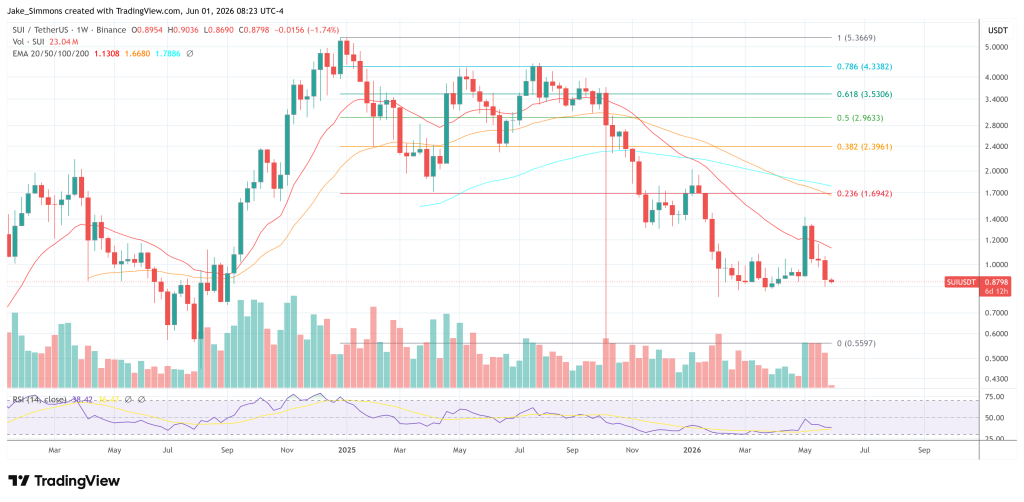
At press time, SUI traded at $0.8798.
Read More
- USD PHP PREDICTION
- Gold Rate Forecast
- USD MXN PREDICTION
- Brent Oil Forecast
- USD CNY PREDICTION
- GBP CNY PREDICTION
- EUR USD PREDICTION
- CNY JPY PREDICTION
- EUR CNY PREDICTION
- Senate’s CLARITY Act: A July 4th Fireworks Display or Political Fire Sale?
2026-06-02 06:12