Aave swaggered into April 2026 wearing the ceremonial badge of DeFi trust, as if trust were a tangible passport that could be stamped by a polite algorithm. It now exits the month navigating the most damaging crisis in its history-one that didn’t bother to break a single line of its own code, which is to say it did a very thorough job of breaking everything else instead.
The bother began at Kelp DAO, where an attacker exploited a vulnerability in the rsETH bridge to drain roughly $292 million worth of tokens. The miscreant then deposited the stolen rsETH as collateral on Aave V3 and borrowed against it. In classic DeFi fashion, you don’t need to steal real money to borrow real money if someone already treated pretend money as if it were the real thing. Because Aave had accepted rsETH as legitimate collateral, there was no real-time mechanism to slap a gate on the deposits. By the time the alarm bells finally rang, between $170 million and $230 million in bad debt had quietly accumulated inside the system, like a rather expensive souvenir collection nobody asked for.
The market’s reaction was immediate and dramatic. Users who had trusted Aave with their assets sprinted for the exits. TVL collapsed in a spectacular fashion as confidence evaporated along with liquidity. The AAVE token, already under pressure from prior departures, slid to a perplexing $93.90, as if it had discovered a new way to express despair in decimal places.
The blame, if blame must be assigned like a badge at a ceremonial stag party, lay not in the protocol’s smart contracts, which remained mostly unscathed, but in its reputation, liquidity, and price. In DeFi, where trust is the product, the difference between an outright exploit and a collateral-triggered crisis is a nuance that would baffle a Vogon printer and amuse precisely no one.
Retail Is Selling. Whales Are Watching. The Bottom May Be Forming
A CryptoQuant report tracking AAVE’s market structure on Binance reveals two stories that diverge depending on which audience you’re glancing at with suspicion and/or curiosity.
The first tale belongs to retail. Exchange reserves have surged sharply-a conspicuous influx of AAVE onto Binance that reads like holders deciding it’s time to relocate to the sell side. The average spot order size has dropped to approximately $80 to $100, signaling that this is fear-driven liquidation by small participants rather than strategic, big-money disposal. When average order sizes shrink to that level, you’re looking at panic, not a master plan.

The second story is more nuanced. Beneath the tide of small sell orders, large whale orders appear sporadically in the lower depths-a handful of deliberate bets testing the current price levels by participants whose behavior seems designed to contradict the retail panic. These orders aren’t consistent or sustained enough to prove a bottom, but they are there long enough to suggest that informed capital is eyeing the current level as a potential entry, not merely a place to exit.
Liquidity on Binance remains thinner than a Vogon love letter, which means selling pressure can move price more easily than in a market with the density of a planetary atmosphere. The bottom conditions are assembling slowly-retail exhaustion visible in the order sizes, whale positioning visible in the occasional large orders. Neither signal is definitive yet. Put together, they describe a market in the early stages of a reluctant crawl from crisis toward whatever might pass for recovery.
AAVE Stabilizes After Capitulation, But Trend Remains Fragile
AAVE is attempting to stabilize around the $90-$100 range after a sharp capitulation phase that reorganised the chart’s furniture. The February breakdown marked a decisive loss of trend, with price slicing through multiple supports and diving into a high-volume selloff. That move framed the current range as a post-crisis consolidation zone rather than a confirmed bottom, a distinction of which investors are particularly fond when they’re tired of pretending it’s all under control.
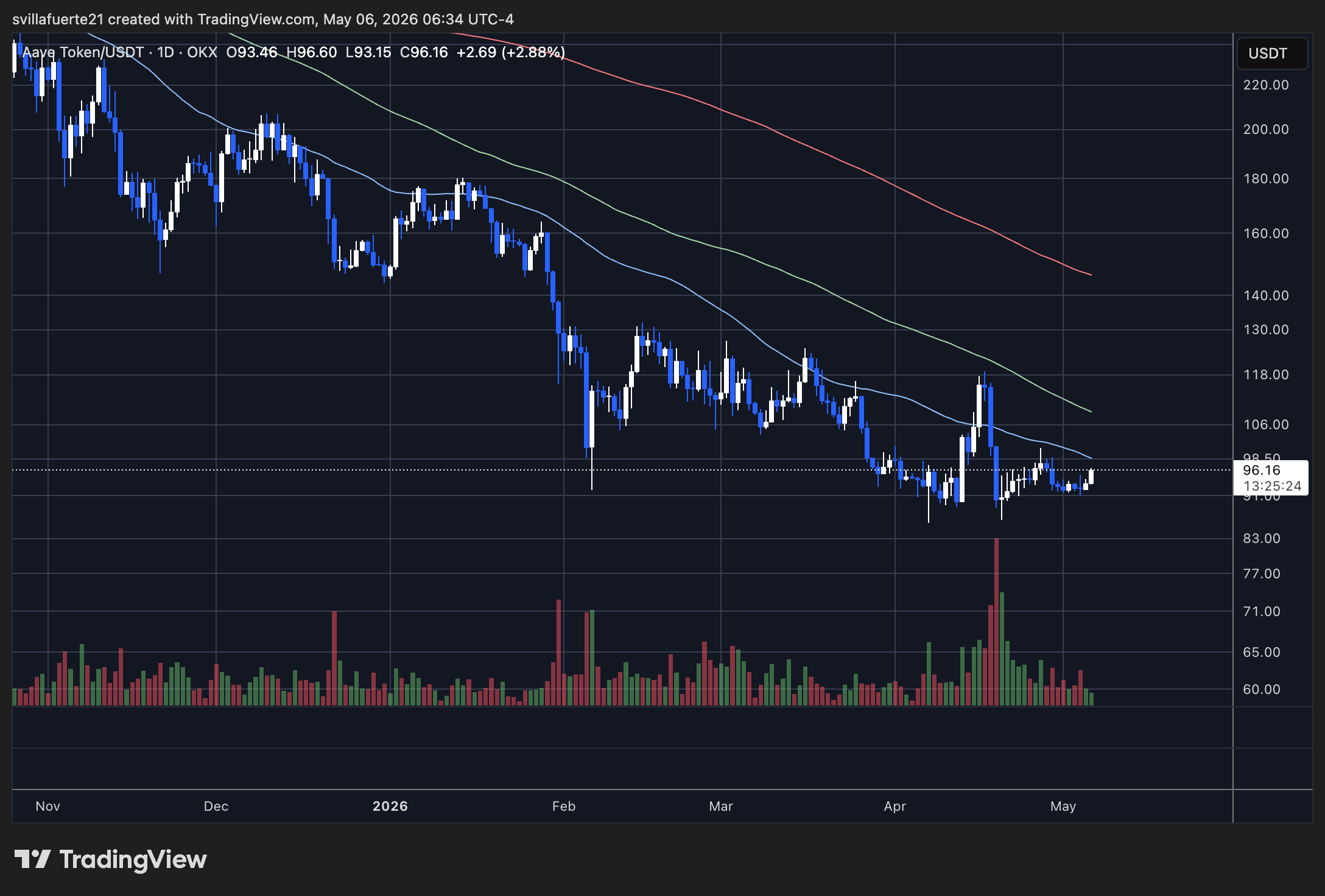
Since then, price action has shifted into compression. AAVE is trading below all major moving averages, with the 50-day acting as immediate resistance and the 100-day and 200-day trending downward above it. This alignment reads like a bearish weather report, suggesting the market is structurally bearish even if it pretends to be calm for a breath or two.
The recent bounce attempts lack follow-through. Sellers repulse each push toward the $105-$110 region, keeping supply active on rallies. Meanwhile, buyers are dipping in near the $85-$90 zone with somewhat steadier ambition. The result is a tightening range, typically a prelude to something-though exactly what remains stubbornly undecided, like a door that keeps opening onto a corridor that leads somewhere else entirely.
Volume behavior supports this interpretation. The capitulation spike hasn’t been matched by an equivalent blast of buying, suggesting that any accumulation, if present, is polite, gradual, and suspiciously reminiscent of a patient snail plotting to buy a spaceship.
A break above $110 would be the first meaningful shift in structure. Until then, AAVE remains in a delicate equilibrium, balancing on a virtual knife-edge while the universe shrugs and checks its towel.
Read More
- USD ILS PREDICTION
- Silver Rate Forecast
- Gold Rate Forecast
- How Bitmine’s Insatiable Ethereum Appetite Is Stirring the Crypto Tea ☕🐳
- You Won’t Believe What This Company Did With $2.54 Billion in Bitcoin!
- XRP PREDICTION. XRP cryptocurrency
- Brent Oil Forecast
- Tesla’s BTC Hoard and $2B SpaceX Gamble: A Tale of Two Wallets
- CFTC vs. Massachusetts: A Legal Game of Musical Chairs
- Ethereum’s Rollercoaster Ride: Why It Might Be Poised for the Ultimate Surge!
2026-05-07 06:58