For the last three years, investing in altcoins (cryptocurrencies other than Bitcoin) has been particularly challenging. Since the crypto market downturn in 2022, prices have struggled to recover, with consistent selling pressure preventing significant gains. Many traders have been hoping for an ‘altseason’ – a period of strong altcoin performance – but it hasn’t materialized, leading to more frustration than profit. As a result, most altcoin investors have simply had to wait and hope for better times.
I’m starting to see a shift in the volume data, and it’s quite interesting. Darkfost, a leading analyst, pointed out that the current market consolidation is impacting trader behavior on Binance. What we’re observing is that during these periods where prices are moving sideways, investors aren’t just holding their positions – they’re actively re-evaluating, and that’s reflected in how volume is being distributed across the platform.
Right now, altcoins make up 51% of all trading on Binance, which is a record high for this period and the first time they’ve been the dominant force in trading volume. This is a big change from early March, when altcoin trading only accounted for 31% of the total as investors focused on Bitcoin and Ethereum during a time of market instability.
Over the past six weeks, this trend has increased significantly, by 20%. Now, the key question is whether this shift represents a real comeback for altcoins, or if it’s just a temporary pause before the market moves again – and the latest data is starting to provide some answers.
Capital Is Rotating — and Ethereum Is Feeling It Most
While altcoins are now responsible for over half of the trading volume on Binance, that money isn’t coming from new sources. Instead, Bitcoin and Ethereum have seen a decrease in trading activity – Bitcoin now accounts for 30% of volume, and Ethereum for 17%. This suggests the market isn’t just adding altcoins to portfolios, but is actually shifting funds away from Bitcoin and Ethereum, especially after a period of market instability.

Ethereum’s recent drop is particularly noticeable. Just two weeks ago, on April 11th, it accounted for 27% of all trading on Binance. Since then, its share has fallen by ten percentage points in less than two weeks, indicating a quick and purposeful shift in trading activity rather than a slow decline.
Darkfost accurately describes what’s happening in the market. Even with ongoing economic uncertainty, money is shifting from safer investments into riskier ones. Traders aren’t backing away from the market due to the recent stagnation; instead, they’re using this period to invest in assets that haven’t done as well during the recent downturn, hoping for a rebound.
It’s unclear whether the recent shift towards altcoins indicates a real belief they’ll bounce back, or if investors are just looking for action during a slow market. The next few weeks should provide clarity, but current trading volume suggests traders have already decided which way to go.
Altcoin Market Cap Rebuilds After Structural Breakdown
The value of smaller cryptocurrencies, excluding the ten largest, is currently finding stability between $180 and $190 billion after a long period of price swings and underlying issues. Looking at the historical data, these assets tend to go through periods of rapid growth followed by significant price drops. The most recent decline, from a peak of $440 billion in 2025, has reduced their overall value by over 50%.
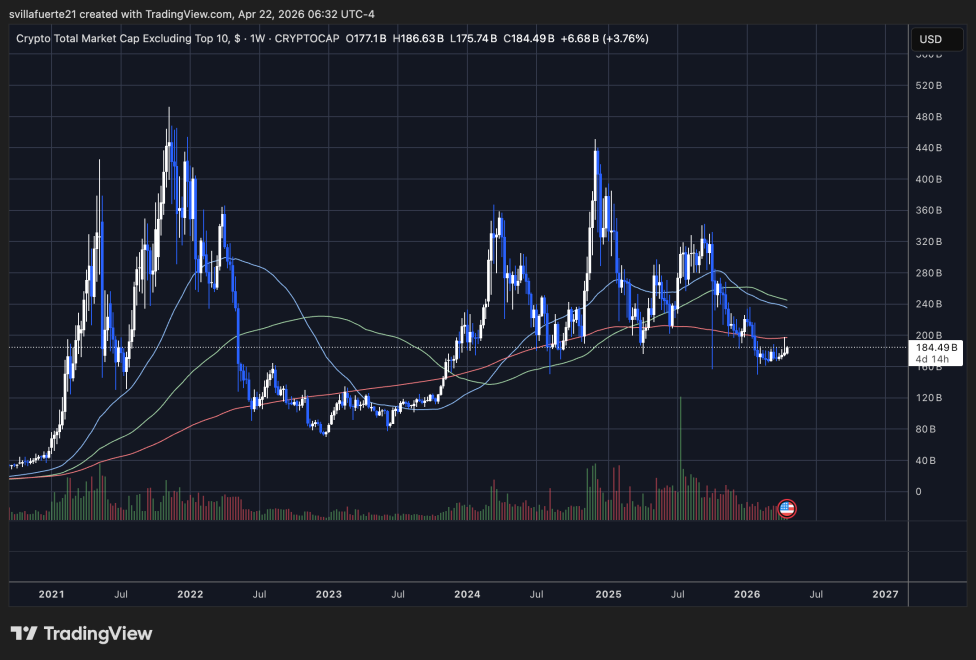
After hitting its lowest point in February, the market has moved from panicked selling to a more stable period. The large increase in trading volume during the drop showed that many investors were forced to sell, signaling widespread concern. However, the rebound since then has been gradual. Importantly, the market has recovered to a key long-term average, which now seems to be holding as a support level, suggesting that longer-term investors are starting to buy again.
Despite recent gains, the overall market structure is still uncertain. Key moving averages are getting closer together, suggesting a period of consolidation that often leads to a significant price swing. Historically, altcoins have behaved similarly, trading within a broad range before either experiencing a strong rally or a price decline.
As a researcher, I’m observing that the market remains cautiously pessimistic until we can consistently regain the $220–$250 billion market capitalization range. To see a real, lasting recovery, altcoins need to definitively break through this resistance level and establish a pattern of higher highs. Right now, it feels more like we’re in a period of rebuilding and consolidation, rather than witnessing a confirmed shift in the overall trend.
Read More
- Brent Oil Forecast
- ATOM PREDICTION. ATOM cryptocurrency
- Silver Rate Forecast
- Bitcoin & Ethereum ETF Outflows Make Investors Cry, Again
- Why Bitcoin is the New Water Cooler Topic: Decline, Drama, and Structural Weakness!
- XRP: A Bounce or a Booby Trap? CasiTrades Says Mind the Gap!
- 🤑 Bitcoin, Bills, and Bold Moves: Lummis’s Crypto Revolution! 🌟
- Gold Rate Forecast
- Bitcoin’s Dance with Destiny: Will It Rise or Fall into the Abyss?
- Fed Fracas: Trump, Powell, and the Stablecoin Wizard in the Race for the Top Hat!
2026-04-23 06:57