Bitcoin’s price often drops after meetings of the Federal Open Market Committee (FOMC), and this trend is becoming increasingly noticeable. Crypto analyst Ardi points out that Bitcoin has decreased in value during the week following eight out of the last nine FOMC meetings, typically falling around 11% on average.
We’re seeing if past patterns will repeat themselves. Bitcoin was trading near $77,000 when the Federal Reserve made its most recent announcement, and historical data suggests this could indicate where the price is headed in the short term.
Bitcoin’s Trend In Post-FOMC Weeks
The Federal Reserve concluded its meeting on Wednesday, April 28-29, and decided to keep interest rates the same, between 3.50% and 3.75%. This move was widely expected, with most analysts predicting no change in rates beforehand.
Crypto analyst Ardi noticed a pattern: Bitcoin’s price has typically dropped sharply in the week after Federal Reserve (FOMC) meetings. Looking at a chart from May 2025 to April 2026, this happened after eight out of nine meetings. The only time it didn’t happen was in May 2025, when Bitcoin had already experienced a significant 24% price decrease before the meeting.
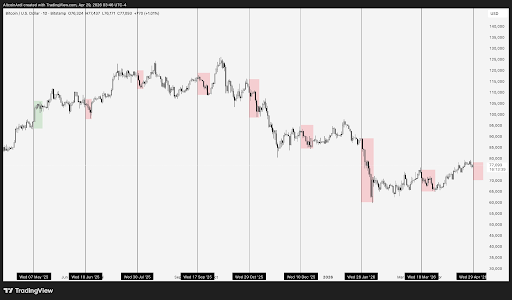
After almost every Federal Reserve meeting, Bitcoin’s price fell, regardless of what the Fed decided. Whether they lowered interest rates, kept them the same, or signaled a more restrictive policy, the price consistently went down, suggesting the Fed’s actions had little impact.
Ardi’s chart clearly illustrates a recurring pattern of price drops following Federal Open Market Committee (FOMC) meetings. It shows periods of selling – marked in red – happening in September, October, and December 2025, and again in January and March 2026. These drops occurred as Bitcoin’s price fell from its peak of over $126,000 in October 2025 to the $60,000s by early February 2026.
An Average Drop Of 11%
Ardi’s analysis shows a clear pattern: Bitcoin tends to fall in value after Federal Open Market Committee (FOMC) meetings. In fact, it’s dropped in eight out of the last nine instances, averaging an 11% decrease in the week following each meeting.
If Bitcoin’s price were to drop 11%, it would land around $70,000. This is based on its current trading range of $76,000 to $79,000, following a strong 21% increase in April from a low of about $65,000.
The Federal Reserve reported that the economy is growing steadily, but inflation remains high, especially due to rising energy costs worldwide. This is important for Bitcoin, which reacts strongly to expectations about how much money will be available. If the Fed signals it will lower interest rates, that generally encourages investment, weakens the US dollar, and boosts confidence in cryptocurrencies. However, if the Fed is hesitant, it has the opposite effect.
Bitcoin has been bouncing back from its recent low point, showing a positive trend in April. However, the upcoming Federal Open Market Committee (FOMC) meeting could create uncertainty, potentially leading to another rise toward $70,000 in the short term.

Read More
- Brent Oil Forecast
- Silver Rate Forecast
- Gold Rate Forecast
- Israel’s Markets Soar Amid War – What’s the Secret?
- Morgan Stanley’s Bitcoin ETF: Wall Street’s New Gamble
- Ripples of Praise: CEO Throws a Toilet Bowl at SEC Chair – You Won’t Believe Why!
- ETH PREDICTION. ETH cryptocurrency
- Ethereum’s Magical Journey to $4,000: A Tale of Whales, Wizards, and ETFs 🧙♂️💰
- EUR AUD PREDICTION
- OpenSea’s CTO Dishes on the Future Beyond NFTs: A Dash of DeFi and a Pinch of AI 🌟
2026-05-01 21:32