Two bullish signals fired like a starting pistol at a raccoon convention. Here’s how the crypto circus might unfold.
Bitcoin’s been throwing hints so obvious, even my goldfish would’ve taken a second glance. Two rare bullish signals lit up the charts last week, and analysts are now scribbling “$84,000 by Friday” on napkins like it’s a winning lottery ticket. Because nothing says “trust us” like historical data and a 75% success rate. Classic crypto.
DeFi researcher Sherlock (yes, that’s his actual handle) pointed out a pattern so simple, it’s almost insulting. Break out of four-plus weeks of consolidation with a weekly gain over 5%, and suddenly the market’s a green-lit rom-com. Since 2017, this trick worked 75% of the time. The average gain? A modest 5.43%. Over four weeks, it’s a 15.73% bonus. If you’re not impressed, maybe you need a nap.
The second signal was equally dramatic. Last week closed green, Sunday dropped 3.15%, then this week BTC clawed back 8.37% plus the losses. Sherlock claims this sequence has only happened five times in Bitcoin’s history. Five! That’s like finding a unicorn in your backyard and calling it a “common occurrence.”
Every time BTC breaks out of a 4+ week consolidation with a 5%+ gain, the next week closes green 75% of the time. Four-week returns average 15.73%. Coincidence? Probably not. Or maybe it’s just crypto’s version of Russian roulette.
– Sherlock | DeFi Researcher (@Sherlockwhale)
These signals, when combined, boast a 75%-99% accuracy rate. Sherlock’s projections? $80,000 by Friday if the consolidation breaks, $84,000 if the red Sunday rebound kicks in. Because nothing says “reliable forecast” like betting on patterns from a decade-old dataset. Let’s hope the coffee hasn’t gone cold by then.
Negative Funding Rates: Short Squirrels in a Bear Trap
Crypto analyst @CryptoBusy added another layer to the chaos. Funding rates on Bitcoin futures are deeply negative, meaning shorts are in a tight spot. Imagine a squirrel caught in a bear trap, but instead of a nut, it’s traders scrambling to cover their bets. History shows this setup often precedes a short squeeze-a fancy term for “panic buying.”
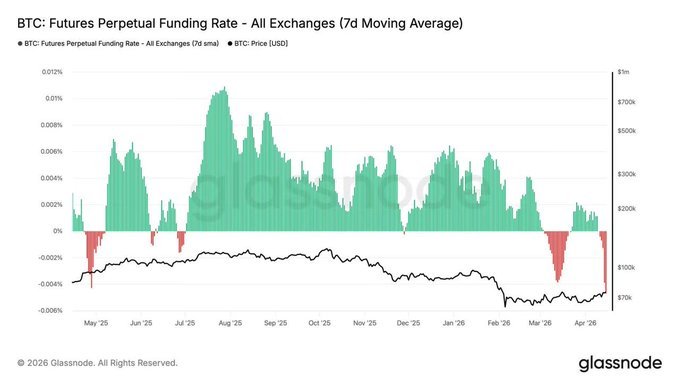
Short squeezes are the financial equivalent of a toddler spilling juice on the floor and then dancing in it. Prices spike, shorts panic-buy to minimize losses, and the cycle repeats until someone invents a mop. CryptoBusy noted that neutral funding rates suggest normalization, but until then, expect more chaos than a toddler’s playdate.
Bitcoin’s Power Law Model: A Love Letter to Oversold Conditions
As of CoinGecko, Bitcoin trades at $77,831.12. That’s $56 billion in 24-hour volume, because who doesn’t want to spend $56 billion on coffee? Analyst @david_eng_mba leaned on the Power Law model, which pegs Bitcoin at $128,454. But here’s the kicker: the z-score of -0.77 means BTC’s in “oversold” territory. By this logic, mean reversion targets $110,000 by year-end, with a trend target of $159,000. Let’s hope the market doesn’t decide to break the model mid-party.
Bitcoin at $77K. Mean reversion: $110K. Trend: $159K. Z-score: -0.77. Oversold? Yes. Confident? No.
– David (@david_eng_mba)
So, will Bitcoin hit $84,000 next week? Maybe. But given the history of crypto predictions, it’s about as reliable as a weather forecast from a parrot. Still, the technical signals, funding rates, and Power Law models have everyone buzzing. Whether it’s a bull run or a bear trap, one thing’s certain: the crypto circus is back in town, and the popcorn’s getting thrown around.
Read More
- Bitcoin Surges as Iran Ceasefire News Shakes Oil Markets!
- XRP’s Desperate Dance with Bitcoin: A Tragicomedy in Three Acts
- Silver Rate Forecast
- Gold Rate Forecast
- Coinbase Rejects Senate’s Stablecoin Yield Compromise: Crypto Legislation in Limbo
- Circle’s Plunge: A Farce of Fear and $75B Dreams!
- You Won’t Believe What DBS Just Did with Crypto! 😲💰
- Polymarket’s Bold Move: DeFi Startup Acquired for $20B Ambitions!
- Tajikistan’s Crypto Crackdown: Jail & Fines Await Bitcoin Miners! 🚫💰
- Litecoin’s Accumulation Zone Hints at Massive Rally: Is a Breakout Imminent?
2026-04-17 19:44