Well, butter my biscuit and call me Liz Lemon, because the SEC just busted a Texas entrepreneur for pulling a fast one with fake AI trading bots. Nathan Fuller, the mastermind behind Privvy Investments, allegedly raised $12.3 million from 150 investors by promising them the crypto moon. Spoiler alert: the bots were about as real as my patience for slow walkers.
-
Key Takeaways (or as I like to call them, “The CliffsNotes for the Attention-Span Challenged”):
- Fuller raised $12.3 million from 150 investors using AI bots that were faker than a reality TV romance (2022-2024).
- Only $380,000 (a whopping 3%) actually bought crypto. The rest? Well, let’s just say Fuller’s wallet got a lot heavier.
- $6.2 million allegedly went to personal luxuries like a house, gambling, and probably a few “World’s Best Boss” mugs. Classic.
- This case joins the 2026 trend of AI-themed crypto scams, because nothing says “innovation” like slapping AI on a Ponzi scheme.
A “Crypto Arbitrage” Operation Built on a Lie (and Probably Some Glue Sticks)
According to the SEC’s complaint, Fuller pitched investors on a crypto arbitrage operation powered by AI bots that could trade faster than I can eat a whole sheet cake. These bots, he claimed, could scan markets 24/7, execute trades, and cap losses. The promised returns? 40-50% in 30-45 days. Or, you know, just enough time to realize you’ve been bamboozled.
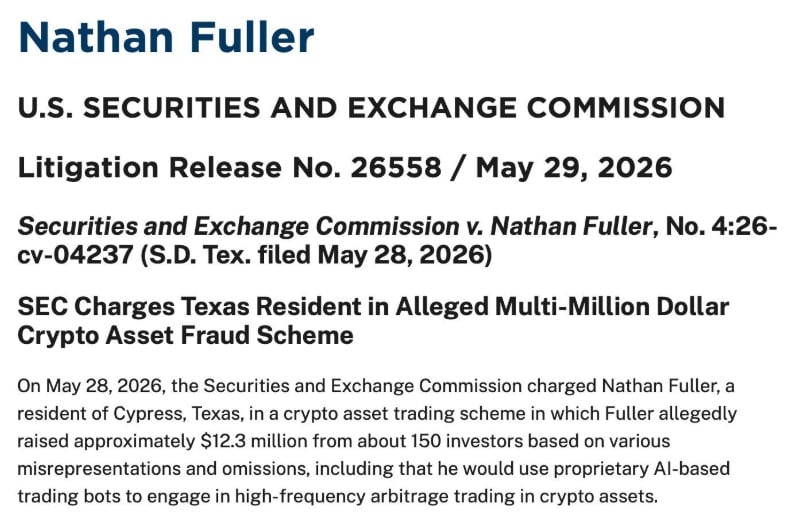
Turns out, the bots were neither AI nor functional. They were basically the financial equivalent of a Chia Pet-all hype, no payoff. Of the $12.3 million, only $380,000 was used to buy crypto, and those trades were about as successful as my attempt to cut carbs.
Where the Money Actually Went (Hint: Not to Investors)
Fuller allegedly misappropriated $6.2 million for personal use, including a house, gambling, travel, and vehicles. Because nothing says “trustworthy investment” like a guy who blows your money on a new car. The remaining $5.5 million went toward Ponzi-like payments, which is just a fancy way of saying he used new investors’ money to pay old investors. It’s like a financial game of musical chairs, except no one wins.
When investors started asking for their money back, Fuller went full-on Kenneth Parcell with the excuses. He produced fake account statements, referenced non-existent entities, and even used AI to generate a letter from a fake auditing firm. Because if you’re going to lie, might as well use the latest tech to do it.
This case fits right into the 2026 trend of fraudsters slapping “AI” on their scams. Last year, the SEC went after an alleged AI trading kingpin behind a $198 million Ponzi scheme. Before that, they charged four people in a $295 million crypto Ponzi that duped over 100,000 investors. So, yeah, Fuller’s $12.3 million is small potatoes, but it’s still a big ol’ red flag.
What the Charges Mean (or “The Part Where the Grown-Ups Step In”)
The SEC charged Fuller with violating securities laws and is seeking injunctions, disgorgement of ill-gotten gains, and civil penalties. Basically, they’re saying, “Give the money back, buddy.” For investors, this is a reminder that if something sounds too good to be true (like 50% returns in a month), it probably is. Especially if it involves “proprietary algorithms” or “AI bots.” Those are just fancy words for “I’m making this up as I go.”
The case now heads to federal court, where Fuller will have his day in court. If the SEC wins, investors might get some of their money back, though in Ponzi schemes, recoveries are usually about as likely as me winning a hot dog eating contest. So, stay tuned, folks. This financial soap opera is just getting started.
Read More
- Gold Rate Forecast
- USD MXN PREDICTION
- EUR GBP PREDICTION
- EUR KRW PREDICTION
- USD CNY PREDICTION
- EUR HKD PREDICTION
- CNY JPY PREDICTION
- CNY RUB PREDICTION
- Silver Rate Forecast
- Brent Oil Forecast
2026-06-01 11:57