Aya Miyaguchi, president of the Ethereum Foundation, explained the organization’s new direction, describing it as a fresh start. She said this change was needed after disagreements within the Foundation caused tension, and as the organization struggled to balance many competing priorities.
The comments come at a delicate time for the Ethereum Foundation, a key nonprofit organization. They were posted on X (formerly Twitter) shortly after Vitalik Buterin, Ethereum’s co-founder, shared his thoughts on the Foundation’s future. Currently, the Foundation is restructuring to become leaner and more focused, even as the wider Ethereum community discusses how it should be governed, what technology it should prioritize, and addresses several important staff leaving.
Ethereum Foundation Enters New Power Era
According to Miyaguchi, the decision originated with the board, though she initially suggested it late last year. She explained it wasn’t caused by one specific issue, but rather a larger problem: EF was facing conflicting demands from different groups.
She explained that discussions, originally focused on technical details, increasingly became about politics and personal feelings, and were often influenced by hidden motivations. Additionally, as the organization grew, differing ideas about its purpose created internal conflict. She felt that trying to please everyone would ultimately prevent them from accomplishing anything.
This issue gets to the heart of the Foundation’s challenge. While Ethereum has always depended on the EF for funding, organization, and guidance, the Ethereum community has also resisted having one central authority. Miyaguchi highlighted this tension, suggesting that the EF’s lessened control isn’t a sign of backing away from its duties, but rather evidence that Ethereum has grown beyond needing a single leading institution.
As we’ve stated before, the Ethereum Foundation is just one part of the larger Ethereum ecosystem. While the Foundation was crucial in the beginning and helped get things started, it wasn’t intended to be the central authority forever. It’s understandable that this can be difficult for some to accept, given the Foundation’s early leadership role.
Miyaguchi explained that her beliefs stem from her long involvement with cryptocurrency, starting in 2012. She joined Kraken in 2013 just before the Mt. Gox exchange failed, and she even assisted with the aftermath. This experience taught her valuable lessons about both the potential for growth and the dangers of centralizing power. When she became an executive director in 2018, she focused on helping Ethereum expand beyond the Ethereum Foundation.
The Foundation intentionally chose to share power instead of holding onto it, explained Miyaguchi. They’ve helped launch successful projects like Uniswap and ENS, supported events like ETHGlobal and hackathons, and provided funding to organizations like Gitcoin and Moloch that further support the ecosystem. Their main focus, she said, was always whether a project could thrive independently, without ongoing support from the Foundation.
Miyaguchi explains that this approach has resulted in the Ethereum Foundation holding less than 0.2% of all Ether, and intentionally limiting its overall influence. Their current focus, she says, is to maintain and improve what makes Ethereum special – its competitive advantages and the reasons developers choose to build on it. This centers around concepts she calls CROPS, and ensuring users have complete control and can coordinate freely without interference.
We know we can’t succeed by ourselves, and we don’t plan to try. However, establishing a clear, shared goal for this effort and working together with our partners is something we’re committed to doing.
Miyaguchi disagreed with the notion that a more focused Ethereum Foundation (EF) would mean less effort towards wider adoption. In fact, she believes the opposite is true, explaining that both regular users and organizations rely on the fundamental benefits Ethereum offers. While the EF continues to support adoption – including from institutions – it will only do so in ways that align with its core goals.
These comments follow a significant number of departures from the Ethereum Foundation (EF) in 2026, including key researchers and community leaders like Carl Beekhuizen, Julian Ma, Barnabé Monnot, Tim Beiko, Trent Van Epps, Josh Stark, and former co-executive director Tomasz Stańczak. This turnover has led to increased questions about whether the Foundation’s recent changes represent positive decentralization, internal difficulties, or a combination of both.
Miyaguchi openly discussed the changes to the team. She explained that as EF clarifies its direction and becomes more focused, the team will inevitably become smaller and more specialized, which was a deliberate decision. She also noted that new leaders are taking charge and that management will share more details about the new organization and plans in the near future.
Vitalik Buterin’s post on May 24th introduced the topics discussed by Miyaguchi. Buterin explained that the Ethereum Foundation is still evolving, clarified he doesn’t have ultimate control over its direction, and noted that another leader is currently driving much of the change. He also envisions a future where the Foundation is smaller and more streamlined, shifting its focus from being the central authority of Ethereum to protecting the network’s core strengths.
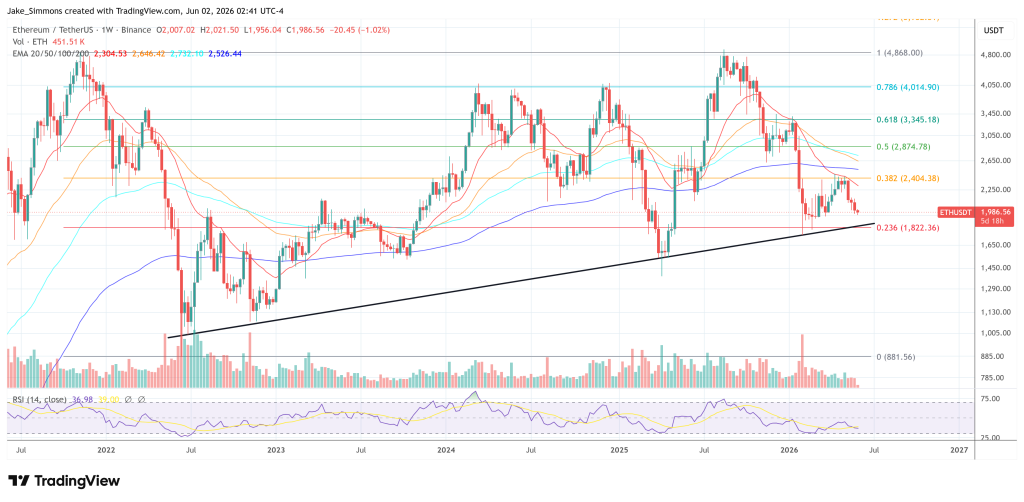
At press time, ETH traded at $1,986.
Read More
- USD CNY PREDICTION
- Gold Rate Forecast
- USD MXN PREDICTION
- CNY RUB PREDICTION
- Senate’s CLARITY Act: A July 4th Fireworks Display or Political Fire Sale?
- CNY JPY PREDICTION
- EUR GBP PREDICTION
- Silver Rate Forecast
- EUR KRW PREDICTION
- USD BRL PREDICTION
2026-06-02 14:13