South Korea’s National Policy Committee did the unthinkable: they postponed the “second-phase” crypto act debate until after June 3 local elections. Because nothing says “urgent legislative action” like letting politicians focus on their own survival first. Priorities!
Crypto Framework Postponed In A Time Of Need
According to Maeil Business Newspaper, the crypto industry is now even more confused than a TikTok algorithm trying to figure out why you like cat videos. The Framework Act on Digital Assets was excluded from the March 31 agenda, leaving lawmakers to shuffle five finance bills instead-none of them crypto-related. They did, however, forward a partial amendment to the Virtual Asset Users Act. Progress? Sure. Direction? Let’s call it “ambiguous with benefits.”
Lawmakers decided to park the crypto bill like a problematic ex during an election window. Why? Because arguing about bank ownership caps and stablecoin rules might not play well with voters. Speculation suggests the presidential office and FSC are clashing over how to treat stablecoins and ownership limits. If this were a reality show, they’d call it “Crypto: The Real Housewives of Seoul.”
The proposed framework arrives just in time for what feels like the 10th season of “Korean Crypto Drama: The Series.” The two main plotlines? Stablecoins and equity caps. Spoiler: nobody wins.
The Stablecoins Fight
South Korea’s stablecoin saga is a tug-of-war between the Bank of Korea (BOK) and FSC. The BOK wants banks to own at least 51% of any won-denominated stablecoin issuer-because nothing says innovation like forcing banks to run everything. The FSC, meanwhile, thinks that’s as practical as a screen door on a submarine. They argue it’ll lock out fintechs and exchanges, which, you know, actually do the user-facing stuff. But hey, bureaucracy loves a good paradox.
With the Digital Asset Basic Act in limbo, stablecoin issuers are stuck in regulatory purgatory. As one industry insider lamented:
We need the bill to be finalized quickly to determine our business direction, but currently, we are keeping all possibilities open, which is only increasing the cost burden.
Translation: “We’re throwing spaghetti at the wall and hoping it sticks. So far, only the noodles are adhering.”
The Equity-Cap Fight
The FSC wants to treat crypto exchanges like securities markets, capping ownership at 20% (with a 34% loophole for newbies). For giants like Upbit and Bithumb, this means selling down stakes they’ve worked hard to accumulate-over three to six years. Because nothing says “fair competition” like retroactive rules. It’s like telling LeBron James he can’t keep his MVP trophies because the NBA changed the rules in 2024.
What This Means For The Market
South Korea is transitioning from “ad-hoc crackdowns” to a “comprehensive crypto regime.” Translation: they’re still making it up as they go, but now with more paperwork. Delays in stablecoin and ownership rules mean Korean crypto venues are stuck in a high-risk, low-reward limbo. Post-election, expect more favoritism toward big banks and incumbents-because nothing says innovation like giving the status quo a gold star.
If lawmakers finally pass the bill, it’ll either be a green light for KRW crypto products or a cautionary tale about why people should never trust politicians with anything more complex than a vending machine.
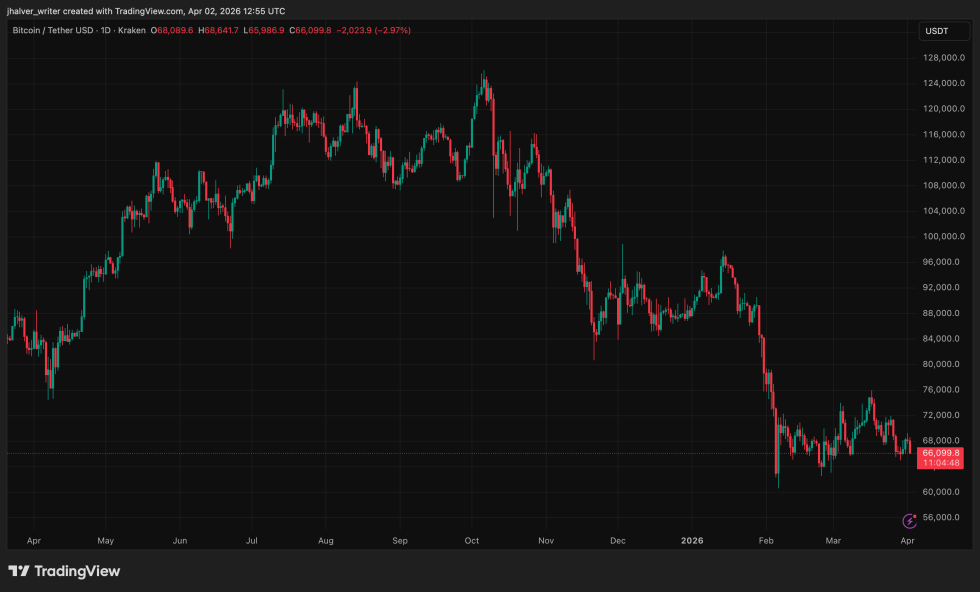
Cover image from Perplexity. BTCUSDT chart from Tradingview.
Read More
- Gold Rate Forecast
- Bitcoin Surges as Iran Ceasefire News Shakes Oil Markets!
- Litecoin’s Accumulation Zone Hints at Massive Rally: Is a Breakout Imminent?
- XRP’s Desperate Dance with Bitcoin: A Tragicomedy in Three Acts
- Silver Rate Forecast
- Stablecoins: The New Corporate Opium or Financial Revolution?
- Brent Oil Forecast
- CoinShares’ Nasdaq Debut: A 25% Crash or Just a Crypto Nap?
- Polymarket’s Bold Move: DeFi Startup Acquired for $20B Ambitions!
- Bitcoin’s Four-Year Cycle? Dead and Laughing at Us All
2026-04-03 07:12