At the end of the first quarter of 2026, Bittensor’s TAO token was trading around $251. The quarter saw a tug-of-war between significant investment from institutions and a governance issue that temporarily caused the token’s value to drop by $650 million.
When Covenant AI, a major player in the network, left on April 9th, the value dropped by 25% almost immediately. This also led to public accusations that Jacob Steeves, one of the network’s founders, was exerting too much control.
Despite recent challenges, the last three months also saw significant investment, including nine-figure funding rounds from Nvidia and Polychain Capital. Additionally, Grayscale and Bitwise both submitted applications for spot ETFs, and AI network usage reportedly generated $43 million in revenue.
Bittensor is at a critical point in its development. While evidence supports the idea that it’s attractive to institutions, some key numbers haven’t been officially confirmed. Here’s a clear look at what the data reveals.
Reported Institutional Allocations: Nvidia and Polychain
A Blockonomi report from April 26, 2026, shows Nvidia invested $420 million in TAO during the first quarter of 2026, with most of that – around 77% – being used for staking. Polychain Capital also reportedly invested $200 million in TAO during the same time, bringing the total known institutional investment to $620 million.
As of now, there’s no publicly available proof on the blockchain to confirm Nvidia’s involvement. Neither Nvidia nor the OpenTensor Foundation has officially confirmed the amount of assets being staked. Polychain Capital has also not made any public statement about this.
The news about Nvidia’s allocation comes as Bittensor has been gaining more attention, especially after Nvidia CEO Jensen Huang discussed it on the All-In Podcast, which was recorded at the GTC 2026 conference.
On March 20th, while speaking with Chamath Palihapitiya, Huang likened Bittensor’s decentralized training network to an updated version of the folding@home project, following Palihapitiya’s explanation of the Covenant-72B training run on Subnet 3.
TAO’s price jumped around 17% that day, reaching over $300 – a level it hadn’t seen since January 2026. Following a discussion on a podcast, the Opentensor Foundation clarified that the model actually has 72 billion parameters, correcting a previous statement that it had only 4 billion.
If the reported amount of Nvidia’s investment is correct, it would be a very large holding of an alternative cryptocurrency besides Bitcoin or Ethereum. However, until we see proof on the blockchain or an official statement from Nvidia, this number should be seen as an estimate, not a confirmed fact.
Real Revenue, Not Just Hype
As an analyst, I’ve observed that institutional investors aren’t swayed by theoretical concepts like whitepapers. They focus on real-world economic performance, and Bittensor’s first quarter results provided the solid financial data they needed to justify investment.
According to a report by Blockonomi, and later shared by crypto analyst Dami-Defi on X, Bittensor’s estimated revenue from AI usage for the first quarter of 2026 is $43 million. This figure is currently the most frequently cited estimate.
If true, this would be a major step forward for AI networks that aren’t funded by simply creating new tokens, but instead earn money by actually providing computing power.
This number has faced significant disagreement. An in-depth economic study released in March 2026 calculated Bittensor’s yearly revenue to be between $3 million and $15 million – much lower than the reported $43 million per quarter.
Our analysis of the Chutes subnet (SN64), which is considered a major source of income, revealed it relies heavily on TAO emission subsidies – receiving between 22 and 40 times more in subsidies than it generates in revenue. Without these subsidies, the cost of running Chutes’ AI models is estimated to be 1.6 to 3.5 times higher than that of competitors like DeepSeek and TogetherAI.
On April 18, 2026, crypto analyst Justin Bons shared a post on X explaining that Bittensor currently brings in $15 million in revenue each year, while its token supply increases by $328 million annually. He argues this means Bittensor relies on financial support rather than genuine user interest to stay afloat.
The difference in numbers probably comes down to what’s included when calculating “revenue.” If the rewards subnet operators receive from TAO emissions are considered revenue, then the $43 million amount could be accurate.
The revenue from Bittensor looks much smaller if you only consider payments from users who directly buy AI services like inference, compute power, or training. Currently, there isn’t a verified and publicly available report detailing Bittensor’s income, and all transactions for these AI services happen outside of the blockchain, meaning they aren’t recorded or verified on it.
To clarify this, investors should look for official revenue reports for subnetworks, either from OpenTensor itself or from independent data companies such as Taostats.
Bittensor plans to significantly increase the capacity of its network by 2026 with an upgrade called Robin. This upgrade will double the number of ‘subnets’ – essentially independent marketplaces for different kinds of AI tasks like processing information, learning, collecting data, and finding answers. While the exact timing isn’t set, this expansion will allow Bittensor to handle twice as much AI activity.
Spot TAO ETF Filings: Grayscale and Bitwise
Tech companies in Silicon Valley are developing the underlying technology for this network, while Wall Street firms are creating investment products that allow traditional investors—those restricted from directly purchasing the network’s digital currency—to participate.
On December 30, 2025, Grayscale Investments submitted paperwork to the Securities and Exchange Commission (SEC) to change its Grayscale Bittensor Trust into a traditional exchange-traded fund (ETF) that will trade on the NYSE Arca exchange under the symbol GTAO.
Established in April 2024 as a Delaware statutory trust, the fund initially held around $7.97 million in assets. On April 2, 2026, Grayscale submitted an updated filing – Amendment No. 1 to its S-1 – to move the application forward with regulators.
Bitwise Investments also submitted paperwork for a TAO Strategy ETF on the same day, as one of eleven different crypto strategy ETFs they’re proposing. Unlike Grayscale’s approach, Bitwise plans to invest 60% of the fund directly into TAO, and the remaining 40% into other exchange-traded products and potentially investments like futures and swaps.
Analysts and news outlets predict the SEC will make decisions on both applications by August 2026. Just five days before the issues with Covenant AI arose, Grayscale significantly increased its investment in TAO within its crypto fund focused on artificial intelligence, making it the fund’s largest single holding ever.
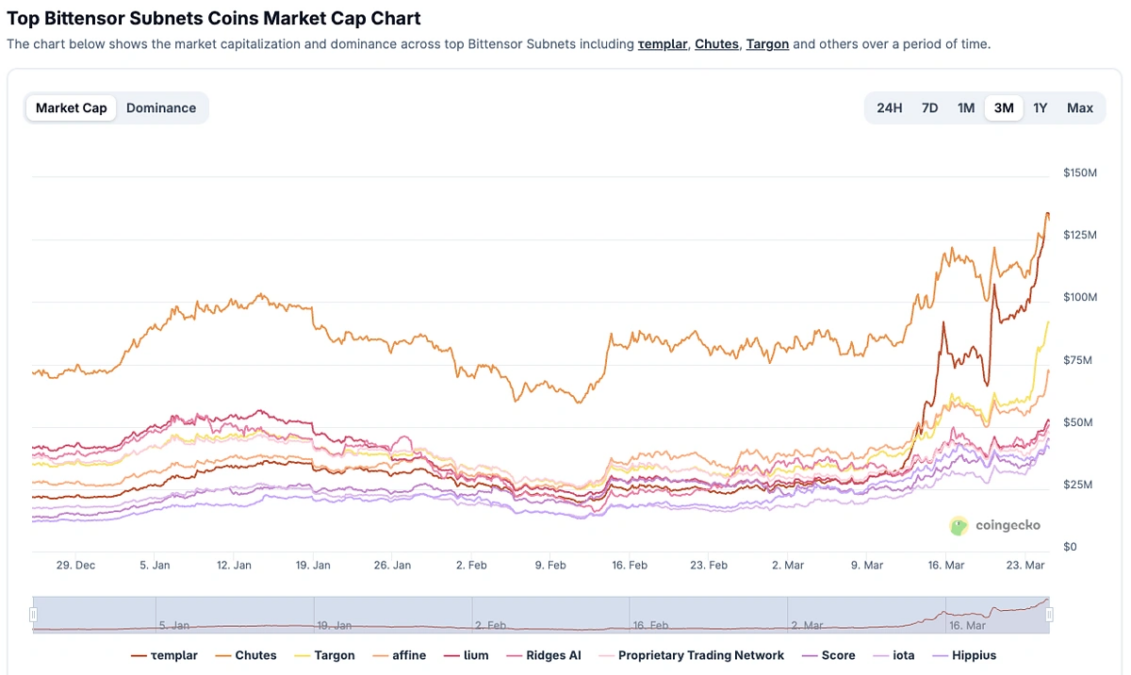
If either product receives approval, it would be the first U.S. investment option that allows investors to directly access TAO while adhering to financial regulations. This would open up access for registered advisors, pension funds, endowments, and other institutional investors who are currently unable to hold the native token, by offering it through a regulated investment structure.
Because TAO doesn’t have as much trading activity as Bitcoin or Ethereum, even a small amount of money entering through ETFs could significantly affect how much is available to buy and sell.
Supply dynamics: The post-halving structure
On December 14, 2025, Bittensor went through its first ‘halving’ event, decreasing the daily creation of new TAO tokens from 7,200 to 3,600 – effectively cutting the supply by half. Similar to Bitcoin, there will only ever be a total of 21 million TAO tokens. As of May 2026, about 10.88 million TAO tokens are in circulation, which represents around 52% of the total possible supply.
Currently, about 68-70% of all TAO tokens are locked up in staking, based on data from Taostats and Coinbase. This means there aren’t many tokens readily available for trading. Adding to this, each new subnet created requires 700 TAO (around $200,000 currently), and if the network expands to its planned 256 subnets, it could potentially remove another $32 million worth of TAO from circulation.
Starting April 20, 2026, BitGo and Yuma will offer secure custody and staking services for tokens used within Bittensor subnets. This is the first time large institutional investors will have a regulated way to directly participate in these subnet economies. Barry Silbert, CEO of Yuma and chairman of DCG, described the launch as a significant step forward for subnet tokens.
Several factors – including a significant drop in new coins entering the market, a large amount of coins being locked up for staking, the potential approval of exchange-traded funds (ETFs), and new services for institutions to securely hold crypto – are creating an interesting balance between supply and demand that traders are closely monitoring. However, as we saw with the Covenant situation, the limited number of coins readily available for trading can cause prices to swing dramatically up or down.
Resilience After the April Storm
The current situation is important to consider. This first-quarter story about institutions isn’t being well-received because the market is already unsettled after a difficult month.
On April 9, 2026, Covenant AI, which runs several parts of the Bittensor network (including Subnet 3, Templar, SN39, and SN81), announced it was leaving. In a post on X (formerly Twitter), Covenant AI’s founder, Sam Dare, claimed that Jacob Steeves, a co-founder of Bittensor, was secretly controlling the system despite portraying it as decentralized.
According to Dare, Steeves acted alone to cut off emissions to Covenant’s networks, took away the team’s ability to moderate community discussions, shut down the network infrastructure, and intentionally created financial pressure by making large token sales during times of conflict.
Covenant then sold around 37,000 TAO tokens, valued at about $10.2 million. This sale caused the price of TAO to fall 25% in just six hours, reducing its total market value by around $650 million. The drop also forced the closure of $9.1 million worth of leveraged trades. Trading activity surged on April 10th, reaching $1.72 billion – more than three times the usual monthly level.
The next day, Steeves responded on X, explaining that he couldn’t stop the emissions. He clarified that his sales of alpha positions on Covenant’s unused networks were normal market transactions, representing less than 1% of his total investment in Dare’s teams.
The aftermath of the initial issue proved even more impactful than the problem itself. Independent miners, working together without leadership from the project creators or the OpenTensor Foundation, quickly reconstructed all three parts of the network using publicly available code – they did it in just a few days. Since Covenant’s network sections were designed for research, the network continued to generate revenue without interruption. By the end of April, the value of TAO had bounced back to around $260, and about 70% of all available TAO tokens were still being used for staking on the network.
After the recent issues with Covenant leaving the network, Bittensor’s team introduced BIT-0011, a new system to stabilize subnet ownership. This system requires subnet owners to commit their tokens for a set period. Control of a subnet is then determined by a formula that considers both the amount of tokens staked and how long they’ve been staked, and this is re-evaluated monthly. The goal is to discourage sudden departures like Covenant’s and provide early warnings if subnet creators start withdrawing their tokens.
When deciding if a project will succeed long-term, investors look for the ability to bounce back from challenges. A token that can recover quickly from issues like changes in leadership, especially while also attracting significant investment, presents a much more promising outlook than one that struggles with every problem it faces.
The Caveats Worth Reading Carefully
Now for the part of this story that responsible reporting has to flag clearly.
Reports about key details – like the size of Nvidia’s investment, how much Polychain contributed, and the $43 million in revenue for the first quarter – have been widely shared by sources such as MEXC, AInvest, and BingX. However, there’s still limited proof directly from the blockchain confirming Nvidia’s investment, and neither Nvidia nor the OpenTensor Foundation has officially confirmed these numbers as of today.
Some users on X are questioning the reported revenue figures, noting that past, independently verified revenue from key areas like Chutes has typically been lower than what’s currently being presented. Others are even more critical, dismissing some of the reporting as low-quality content – essentially recycled press releases pushed by crypto news sites without solid, original reporting.
The core idea behind the story remains valid. However, readers should view the specific financial numbers as general indicators of a trend, not as completely confirmed facts, until official reports or direct confirmation from those involved become available. There’s plenty of evidence from various sources supporting the overall trend – that institutional money is flowing in, ETF applications are progressing, network capacity is growing, and revenue is increasing. It’s the precise amounts of these figures where a bit of caution is sensible.
Over the next few weeks, savvy investors will be looking for three key developments. First, they’ll want to see verified revenue data for subnetworks, either from OpenTensor or other analytics firms. Second, they’ll be watching for official confirmation – or refutation – of Nvidia’s involvement, ideally through blockchain data or public statements. Finally, they’ll be seeking more clarity from the SEC about when decisions will be made on the Grayscale and Bitwise ETF applications.
What This Means for Decentralized AI (DeAI)
Even if the initial numbers are revised later, the first quarter of 2026 set important new standards for the growing field of decentralized artificial intelligence.
Bittensor is a pioneering cryptocurrency project focused on artificial intelligence. It’s currently the first AI-centered crypto with two applications for spot ETFs being examined by the SEC. Bittensor stands out as the most advanced tokenized AI network currently operating, featuring a system where rewards decrease over time (halving), secure institutional storage, and a marketplace for computing power. In March 2026, research confirmed that its ‘Covenant-72B’ training run – which created a 72-billion-parameter AI model with contributions from over 70 individuals using standard computers – was the largest decentralized effort to pre-train a large language model ever recorded.
Whether Bittensor can remain financially stable long-term is still uncertain. If it doesn’t generate enough revenue to match the creation of new tokens, it could end up spending a lot of money to grow without creating a truly self-sufficient system. The recent departure of The Covenant also proved that issues with how the network is governed aren’t just hypothetical – they’re real problems that can lead to significant financial losses, potentially in the tens of millions of dollars.
The next two to three months will be crucial for Bittensor. Whether it can attract institutional investment depends on three key things: the SEC’s decision regarding ETFs in August, the launch of the BIT-0011 Conviction Mechanism, and the availability of verified revenue data. If these factors come together positively, Bittensor could shift from being a promising idea to a solid investment opportunity.
Read More
- USD ILS PREDICTION
- Silver Rate Forecast
- Gold Rate Forecast
- How Bitmine’s Insatiable Ethereum Appetite Is Stirring the Crypto Tea ☕🐳
- You Won’t Believe What This Company Did With $2.54 Billion in Bitcoin!
- XRP PREDICTION. XRP cryptocurrency
- Brent Oil Forecast
- Tesla’s BTC Hoard and $2B SpaceX Gamble: A Tale of Two Wallets
- CFTC vs. Massachusetts: A Legal Game of Musical Chairs
- Ethereum’s Rollercoaster Ride: Why It Might Be Poised for the Ultimate Surge!
2026-05-04 15:36