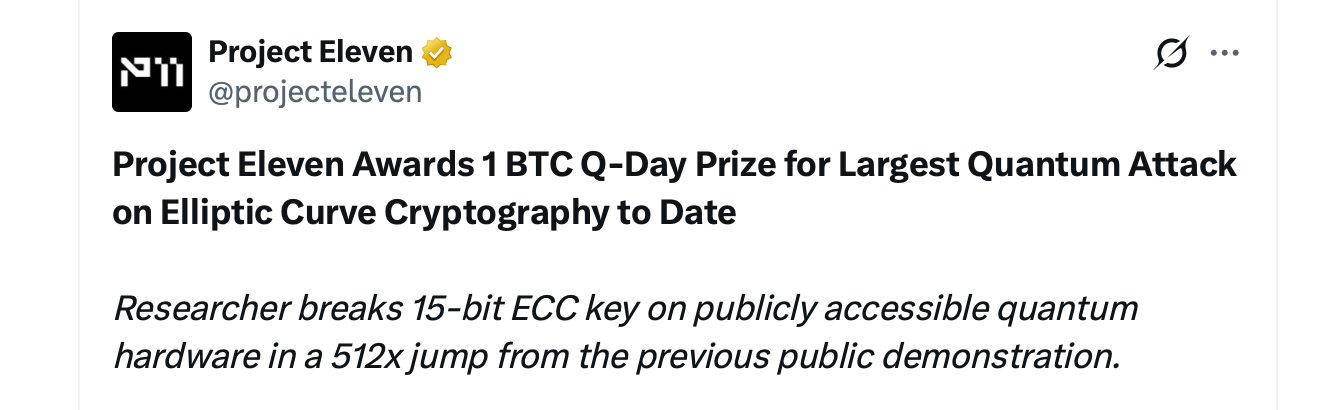
Ah, the grand spectacle of human ambition! On the fateful day of April 24, 2026, the world beheld a triumph of sorts-Project Eleven, that post-quantum startup with a penchant for drama, bestowed upon the humble researcher Giancarlo Lelli a single BTC, a sum of $78,000, for cracking a 15-bit elliptic curve cryptography key on IBM’s quantum hardware. A feat, they proclaimed, of unparalleled grandeur, the largest public demonstration of its kind to date. Yet, in the shadows of this triumph, the Bitcoin developers whispered: “Random noise could have done the same.”
Key Takeaways (or, as Dostoevsky might say, the crumbs from the feast of folly):
- Project Eleven awarded Giancarlo Lelli 1 BTC for cracking a 15-bit ECC key on IBM quantum hardware, a sum that could buy one a modest apartment in the slums of St. Petersburg.
- Bitcoin developers, ever the skeptics, demonstrated that Lelli’s result could be replicated with random noise, rendering the quantum advantage as illusory as Raskolnikov’s redemption.
- The chasm between 15 bits and Bitcoin’s 256-bit secp256k1 remains an engineering abyss, a gap of 2^241, leaving BTC’s security as unassailable as the human soul in the face of existential dread.
Project Eleven, in their grandiose announcement, declared this a 512-fold increase in search-space complexity over a prior 6-bit ECC break. CEO Alex Pruden, with the fervor of a revolutionary, proclaimed that quantum attacks on ECC no longer require the resources of national labs. Yet, the Bitcoin developers, those stoic guardians of cryptographic truth, dismissed it all as “noise,” a term as dismissive as it is accurate.
Lelli’s submission, a two-register variant of Shor’s algorithm, ran across multiple IBM Heron r2 processors, a spectacle of modern technology. Yet, Jonas Schnelli, former Bitcoin Core maintainer, with the precision of a mathematician and the wit of a cynic, reproduced the result in 20 lines of Python using pure random bits. The quantum computer, it seemed, was but a costly random number generator, its grandeur a mere illusion.
Rodolfo Novak, Coinkite founder, with the bluntness of a man who has seen too many charades, called it “theater.” The private key, he insisted, was solved classically before the quantum circuit even ran. The quantum threat to Bitcoin, he admitted, is real but distant. Today’s demos, however, are but classical computations in quantum costumes, a masquerade of progress.
Yuval Adam, with the rigor of a scientist, confirmed the finding by replacing Lelli’s quantum backend with /dev/urandom, Linux’s classical random number generator. The result? Identical. The 15-bit curve, with its meager 32,767 possible private keys, was but a toy problem, solved through near-random sampling. Jimmy Song, ever the provocateur, quipped that the quantum computer was no better than /dev/urandom.
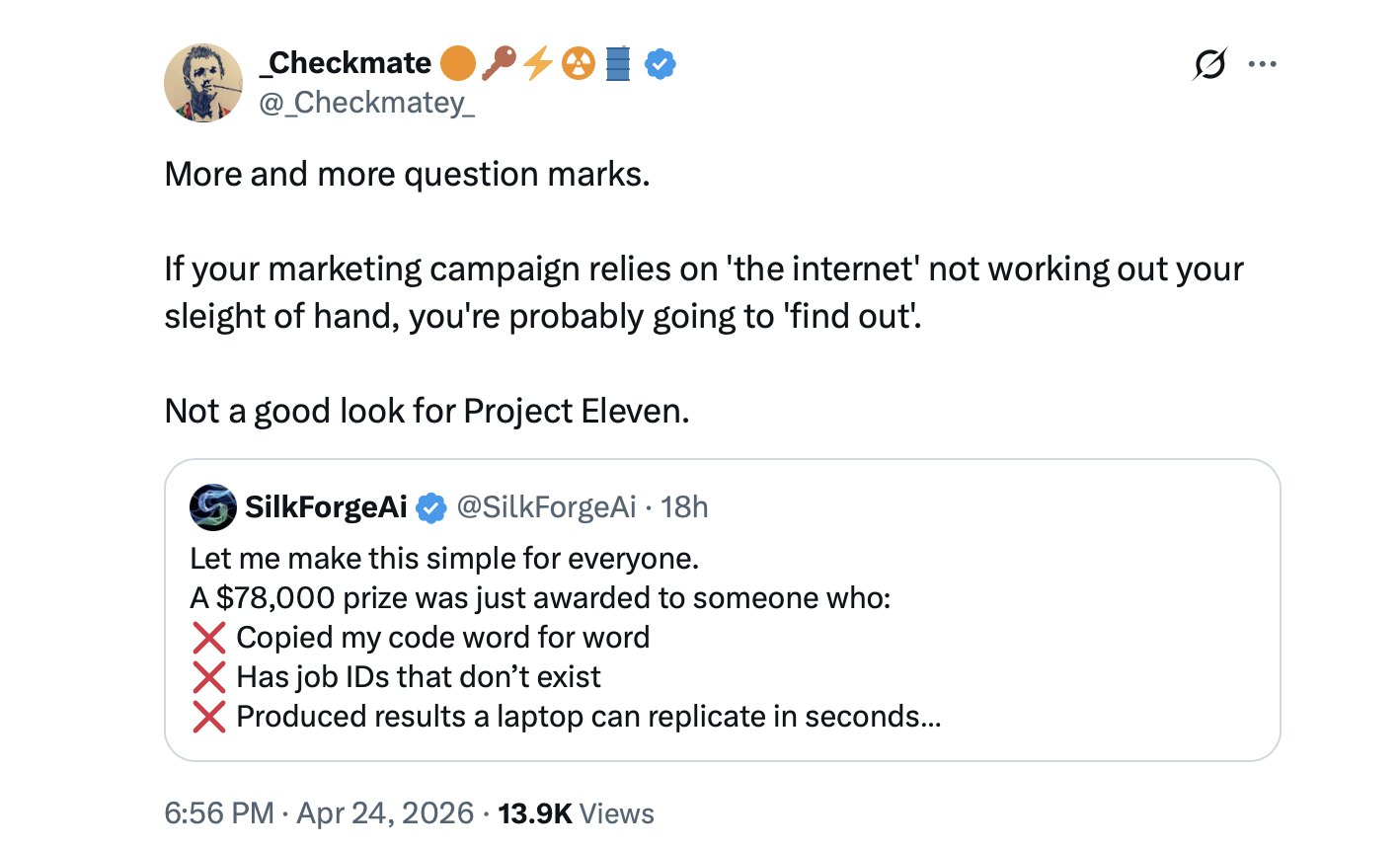
Critics, ever vigilant, pointed to a conflict of interest. Project Eleven, backed by Coinbase Ventures and other luminaries, created the prize, judged the submissions, and then issued press releases warning of the long-term risk to 6.9 million BTC. A convenient narrative, perhaps, for a company selling post-quantum cryptography tools. Pruden, in his defense, acknowledged the result was not Q-Day, but insisted it was incremental progress. Yet, in the grand scheme of things, it was but a footnote in the epic of cryptographic history.
The gap between Lelli’s result and any practical threat to Bitcoin remains vast. Bitcoin’s secp256k1 curve operates at 256-bit security, a chasm of 2^241 in computational difficulty. Even Google’s optimistic research estimates that breaking 256-bit ECC would require fewer than 500,000 physical qubits, a threshold current hardware cannot dream of reaching. The episode, in its absurdity, highlights the tension between incremental milestones and the vast engineering gap that separates us from practical quantum cryptography.
And so, the farce continues. Project Eleven, with their grand pronouncements, and the Bitcoin developers, with their stoic skepticism, dance in a ballet of ambition and reality. The quantum threat, like the specter of God in Dostoevsky’s novels, looms in the distance, a distant possibility that haunts the present. For now, Bitcoin’s security remains intact, a testament to the resilience of human ingenuity in the face of uncertainty.
Read More
- Brent Oil Forecast
- ATOM PREDICTION. ATOM cryptocurrency
- Silver Rate Forecast
- 🤑 Bitcoin, Bills, and Bold Moves: Lummis’s Crypto Revolution! 🌟
- Bitcoin & Ethereum ETF Outflows Make Investors Cry, Again
- Bitcoin’s Dance with Destiny: Will It Rise or Fall into the Abyss?
- Why Bitcoin is the New Water Cooler Topic: Decline, Drama, and Structural Weakness!
- XRP: A Bounce or a Booby Trap? CasiTrades Says Mind the Gap!
- Gold Rate Forecast
- Bitcoin’s Little Bloodbath: Who’s Still Raking It In While Everyone Panics?
2026-04-25 19:57