Solana’s price has fallen back into the $80s after it repeatedly failed to break past $100. This has led to concerns that the price could drop even further, potentially falling below the important $80 support level.
Summary
- Solana price has remained below the key $90 resistance zone after falling nearly 15% from its recent high near $100, with traders watching the $80 support area closely.
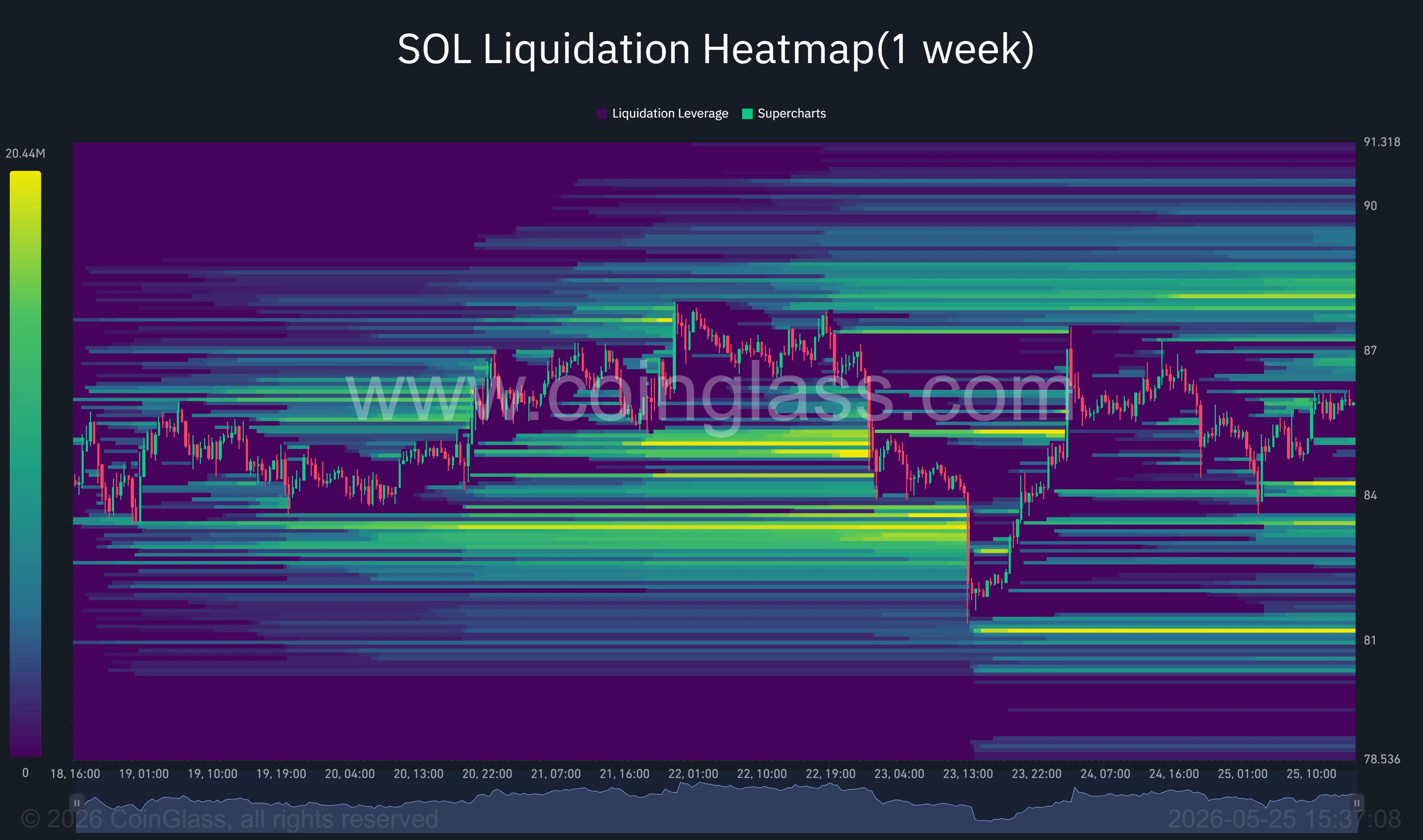
- Daily charts show a developing double-top pattern, while CoinGlass liquidation data highlights dense leverage clusters between $83 and $78 that could accelerate downside volatility.
- Weakening Solana DEX activity, institutional outflows, and persistent macro uncertainty tied to inflation fears and Middle East tensions have continued pressuring sentiment across altcoins.
Solana (SOL) was trading around $85 recently, according to crypto.news data. This is a drop of about 15% from its high of nearly $100 in early May.
The recent downturn happened because large investors have become much more cautious about risky investments in the last couple of weeks. Cryptocurrency investment products in the U.S. saw over $1 billion withdrawn in a single week, as investors scaled back their holdings while awaiting news from the Federal Reserve and the latest inflation figures.
Products connected to the Solana cryptocurrency suffered significant losses after Goldman Sachs announced it had sold off its investments in Solana and XRP exchange-traded products. This move adds to worries that large institutional investors are pulling their money out of riskier, alternative cryptocurrencies.
Solana’s on-chain activity has weakened recently. The surge in trading fueled by meme coins earlier this year has slowed, leading to a significant drop in activity on decentralized exchanges. Weekly trading volume on these exchanges is down over 50% from its peak, which means less revenue from fees and reduced demand for SOL as fewer transactions are happening on the network.
Recently, other platforms have begun to draw users and funds away from applications built on Solana. Base and Hyperliquid are becoming more popular because they offer lower fees and strong demand for perpetual trading. Hyperliquid, especially, is now a significant competitor in the decentralized derivatives market, attracting both trading volume and liquidity from platforms originally based on Solana.
Oil market instability and global political concerns are still negatively impacting cryptocurrencies. The price of oil remains high due to worries about shipping problems in the Strait of Hormuz, and investors are watching talks between the U.S. and Iran closely. Because energy prices are up, it’s becoming less likely the Federal Reserve will lower interest rates, which is making investors less interested in risky investments like Solana.
Is a double-top pattern pointing to another major Solana breakdown?
Recent market signals suggest the situation is becoming unstable. Solana has repeatedly failed to surpass the $98–$100 price level, and its price chart is starting to form a double-top pattern. This means the price tried to rise twice but was pushed back down, ultimately falling back into the mid-$80 range.
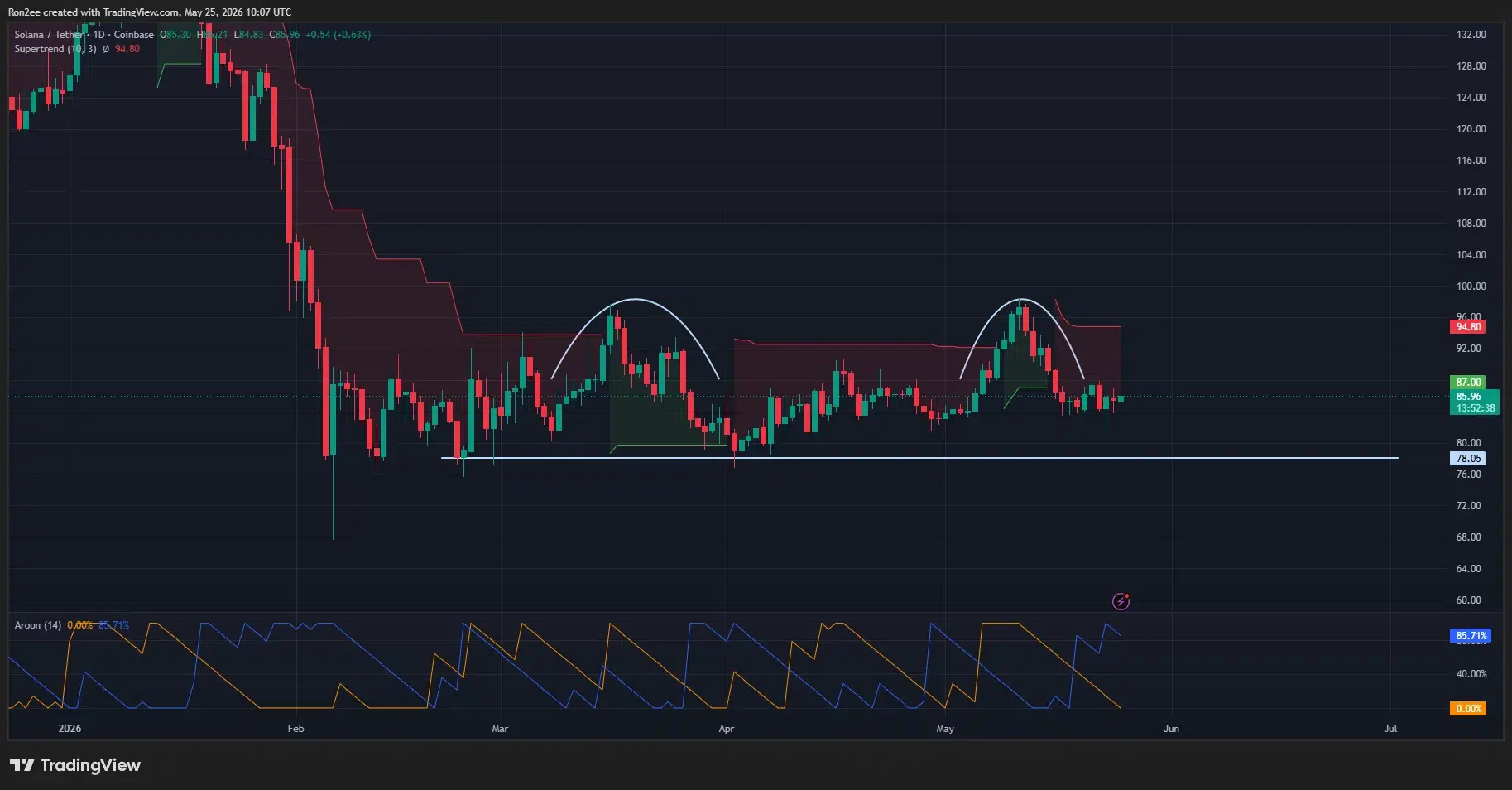
The price is currently finding support around $78, a level that has held strong since March. If the price falls below $78, it could confirm a downward trend and potentially lead to a further drop towards the $70-$78 range.
Based on current market trends, if selling pressure increases rapidly, the price could fall to around $64.
Solana is still facing selling pressure, as its price remains below key resistance levels around $94.80. The price hasn’t been able to consistently stay above a downward-sloping trendline established after a recent drop in late April, which is preventing any significant upward movement.
Technical indicators are giving mixed signals, but generally suggest a continued downward trend for Solana. The Aroon indicator shows some short-term price increases, but has often been wrong during Solana’s recent sideways trading, making a strong recovery seem unlikely.
CoinGlass data highlights key price levels where a lot of leveraged trading is happening, specifically between $83 and $81, and again around $78. If the market becomes more volatile soon, these price points could attract significant buying or selling activity.
Funding rates for perpetual futures have become significantly negative, suggesting traders are heavily betting prices will fall further. This often happens when investors are pessimistic about the market, especially when combined with decreasing demand and less activity on the network.
Even though prices have recently fallen, the number of open contracts hasn’t decreased, which often suggests a significant price drop could happen as people close their positions.
As a researcher, I’m watching Solana closely, and if it falls below the $83 support level, we could see a rapid series of liquidations. This could quickly drive the price down towards $80, which is a key psychological level for traders.
As an analyst, I’m watching Solana closely, and I’m seeing some concerning patterns. The current market structure is reminding me a lot of what we saw in Q3 of 2022, right before some significant price drops. I think there’s a real possibility we could see a short-term rally – what’s often called a ‘bull trap’ – before the price potentially falls further.
If the market keeps getting worse, one trader believes Solana’s price could potentially drop as low as $47.
Even though the market looks generally negative, buyers have been strongly protecting the $83–$84 price range lately. The long shadows on the daily charts show that people are still buying when the price drops near this support level, which has so far stopped the price from falling further.
What could invalidate the bearish Solana thesis?
As an analyst, I’m watching the $90 level closely. If the price can consistently stay above it, that would signal a shift away from the recent downward trend and could force traders who bet against the price to buy back in, potentially driving the price up quickly. CoinGlass data confirms this, showing a lot of ‘short’ positions – bets that the price would fall – are clustered around $87 and $90. A breakout above these levels could therefore trigger a significant and rapid price increase.
Better economic conditions could help calm investors in the crypto market. If U.S. inflation slows down more than expected, or if the Federal Reserve hints at lowering interest rates later this year, we might see more money flow into altcoins. If Bitcoin starts performing well and breaks through key price levels, that could also boost confidence in larger cryptocurrencies like Solana.
How much activity happens on the network is still a key factor. If trading in meme coins picks up or activity on Solana’s decentralized finance platforms bounces back, it could increase fees and renew interest in SOL. Even with a recent dip in users, developers are still working to improve the network’s infrastructure.
Currently, the underlying technology still has weaknesses, and the overall economic climate suggests it’s best to prioritize cautious investments.
If Solana doesn’t rise back to the $90–$94 price range quickly, it could fall below $80. This is because traders are anticipating less available buying and selling activity and increased selling pressure in the overall cryptocurrency market.
Read More
- Brent Oil Forecast
- HYPE PREDICTION. HYPE cryptocurrency
- ONDO PREDICTION. ONDO cryptocurrency
- FIL PREDICTION. FIL cryptocurrency
- USD CNY PREDICTION
- Silver Rate Forecast
- USD VND PREDICTION
- SUI PREDICTION. SUI cryptocurrency
- CNY RUB PREDICTION
- CNY JPY PREDICTION
2026-05-25 13:34