Swift has embarked on a new set of digital asset interoperability trials, which, if we’re being honest, is about as exciting as a well-organized tea party in a bank vault. 🧠✨ This time, the stars are BNP Paribas Securities Services, Intesa Sanpaolo, and Société Générale’s tokenization unit SG-FORGE, with Chainlink and UBS Asset Management playing the role of overenthusiastic butler. The project is said to tackle the “hardest part of institutional tokenization”: getting assets, cash, and operational processes to move cleanly across platforms without forcing banks to abandon their existing rails. (A feat that would make even the most seasoned bureaucrat blush with pride.)
Swift Hits Tokenized-Asset Interoperability Milestone
Chainlink, ever the show-off, posted via X on Jan 15: “As part of Swift’s work with Chainlink & UBS Asset Management, Swift completes landmark interoperability milestone with BNP Paribas, Intesa Sanpaolo, & Société Générale.” 🤯 The trial, described as a “landmark” milestone, focused on the “seamless exchange and settlement of tokenized bonds,” with payments supported in both fiat and digital currencies. Swift claims this is the first time they’ve orchestrated tokenized asset transactions as a single, coordinated process across blockchain and traditional systems. (Translation: They finally figured out how to make a spreadsheet and a blockchain get along.)
The trial also involved SG-FORGE’s infrastructure, which Swift says “harnessed their digital asset and EURCV stablecoin” to enable DvP settlement for tokenized bonds. BNP Paribas Securities Services and Intesa Sanpaolo acted as paying agents and custodians, while Swift argued the settlement flows executing “over Swift” showed tokenized bonds could leverage existing infrastructure. (In other words, no need to rebuild the entire financial system-just add a few more layers of bureaucracy.)
Swift also highlighted standards alignment, saying the initiative showcased integration of ISO 20022 messaging with “blockchain-native platforms.” This, they claim, speaks directly to operational adoption for firms already running ISO-native post-trade and payments processes. (A fancy way of saying, “We’re not asking you to throw out your old systems-just add a few more protocols to the mix.”)
Thomas Dugauquier, Swift’s tokenised assets product lead, cast the effort in institutional terms: “This milestone demonstrates how collaboration and interoperability will shape the future of capital markets. It’s about creating a bridge between traditional finance and emerging technologies.” 🌉 (Translation: “We’re not sure what we’re doing, but we’re definitely doing it with a lot of jargon.”)
Chainlink’s Role
While the bond trial involved European banking counterparts, Swift explicitly tied the work to a broader sequence of pilots, including “bridging tokenized assets with existing payment systems with UBS Asset Management and Chainlink.” In that earlier UBS pilot, Swift, UBS Asset Management, and Chainlink tested a model for settling tokenized fund subscriptions and redemptions while keeping cash settlement compatible with existing fiat rails. (A process so complex, it’s a wonder anyone can afford to invest.)
Swift also pointed to other recent experiments spanning fiat and digital currency settlement with Citi, digital asset transaction exchange with Northern Trust, and the Reserve Bank of Australia, and ISO 20022-based blockchain interoperability with HSBC and Ant International. (A veritable who’s who of financial innovation-assuming “innovation” means “adding more paperwork.”)
Beyond technology, Swift said it has submitted proposed market practice guidelines to the Securities Market Practice Group, arguing that innovation in digital assets should not come “at the expense of systemic stability” and that clearer practices can reduce onboarding complexity for institutions. (In other words, “We’re not trying to disrupt the system-we’re just trying to make it more complicated.”)
With the trial series “now complete,” Swift said it is focused on adding “a blockchain-based ledger” to its infrastructure stack, starting with real-time, 24/7 cross-border payments “designed in collaboration with over 30 banks worldwide.” (A noble goal, but one wonders if the banks are just there to sign off on the chaos.)
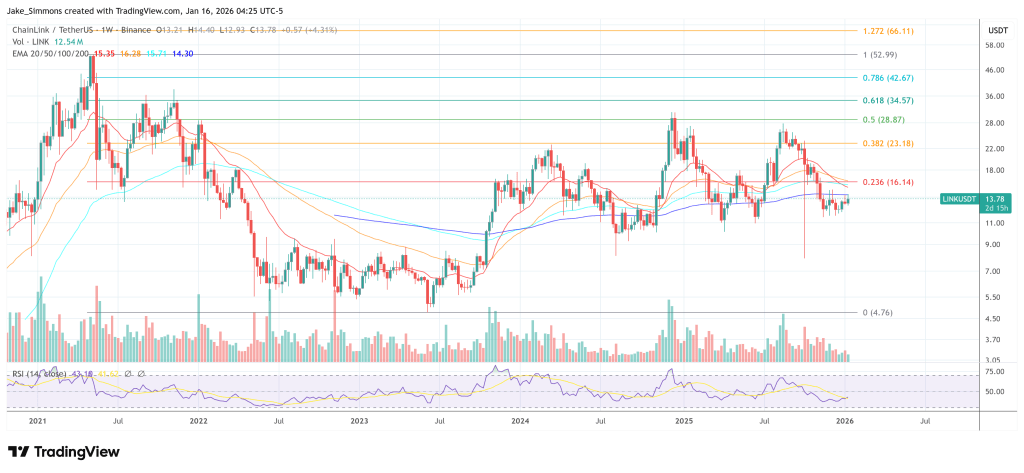
At press time, Chainlink (LINK) traded at $13.78. 📈
Read More
- CRO PREDICTION. CRO cryptocurrency
- Brent Oil Forecast
- Why Is Everyone Obsessing Over These Cryptos? 🤔
- EUR THB PREDICTION
- USD JPY PREDICTION
- BNB Hits ATH, But Bearish Whispers Grow 🚀💸
- USD MXN PREDICTION
- Gold Rate Forecast
- AVAX Poised for a Jump: Why the Next $80 Might Just Be a Matter of Time
- Economist Reveals His Biggest Bitcoin Mistake – You Won’t Believe What It Is
2026-01-16 18:27