More and more individual investors are buying shares of private companies – particularly those in AI, finance technology, and cryptocurrency – *before* they become publicly traded. They’re willing to pay a significant premium – sometimes 40% more – than what these companies were recently valued at in private funding rounds.
A recent report by DWF Labs, a company that makes markets in digital assets, suggests that the technology supporting these blockchain-based products isn’t fully developed and lacks transparency. This creates potential risks for investors, especially when the companies behind these products eventually become publicly traded.
A new study, shared first with *The Crypto Times*, reveals that strong demand is outpacing available supply. While initial public offerings (IPOs) are predicted to bring in around $160 billion this year, the report cautions that the current market—characterized by a lot of excitement but limited available assets and a lack of careful risk management—hasn’t been tested with this level of activity before.
It now takes companies about 12 years to go public (IPO), which is twice as long as it did in the 1990s when it typically took four to five years. Because of this change, companies are growing rapidly for longer while remaining private, leading investors to seek new opportunities through things like blockchain tokens and derivatives.
DWF Labs, a company specializing in cryptocurrency trading and research, recently investigated how everyday investors are currently buying and selling crypto. Their research revealed ongoing issues with inaccurate pricing, difficulties cashing out, and a lack of the usual market regulations that typically stabilize prices.
I’ve noticed a big shift in how companies grow. They’re staying private much longer – about twice as long as they used to in the 90s, according to DWF Labs. What that means is the biggest, most exciting growth happens *before* a company goes public. So, as an investor, I’m seeing more and more demand for opportunities in the crypto space, where we can access that early growth potential directly on the blockchain.
The Extended Private Era: Growth Locked Behind Closed Doors
The data reveals a significant shift in the tech world. While startups in Silicon Valley used to go public quickly – often within five years – today’s most valuable private companies, particularly those focused on artificial intelligence, are choosing to stay private for much longer. This allows them to avoid public oversight while their value increases rapidly, creating an opportunity for new, digital financial systems to step in and meet the demand.
Individual investors, typically excluded from venture capital and secondary markets designed for larger institutions, are now exploring fractional ownership through blockchain technology. However, the necessary supporting systems haven’t fully developed to meet this growing demand.
Currently, many tokens representing shares in companies before their IPO don’t have reliable pricing mechanisms. Because it’s usually impossible to bet against these tokens, their prices often stay artificially high. This means when the company finally goes public – and its price is often at or below its last privately assessed value – token holders could experience significant financial losses.
Hiive, a popular platform for buying and selling private company stock, offers a glimpse into current investment trends. Artificial intelligence (AI) companies are involved in the most deals, but cryptocurrency companies see the highest demand for shares from each individual company. In 2025, the average transaction was worth over $1 million, showing that Hiive mainly caters to institutional investors.
From my analysis, retail investors are primarily engaging with crypto through more readily available, but potentially riskier, on-chain platforms. Interestingly, even *before* the buzz around tokenizing private equity, we saw strong performance from pre-IPO companies. Last year, the Hiive50 index – which tracks the 50 most liquid pre-IPO names with equal weighting – actually outperformed the S&P 500, demonstrating clear demand for this type of asset.
Three On-Chain Structures: SPVs, Synthetics and Closed-End Funds
As a crypto investor, I’ve been watching how people are getting access to pre-IPO companies, and I’ve noticed three main ways it’s happening. Each one works a little differently, comes with its own set of risks, and seems to attract a different type of investor.
As an analyst, I’ve been looking closely at SPV-backed tokens, and here’s how they work. Essentially, a Special Purpose Vehicle (SPV) actually *holds* the private shares or the rights to them. The tokens you buy then represent a proportional claim on whatever assets that SPV is holding. On paper, this structure aims to get as close as possible to genuine ownership of those private assets. However, the ability to actually redeem those tokens for value depends entirely on the SPV being able to sell or transfer those underlying assets, and that’s often limited by restrictions in the private company’s shareholder agreements.
Both OpenAI and Anthropic have spoken out against unofficial sales of company shares and have stated they will tightly control how those shares are transferred. If the estimated value of these shares doesn’t match the actual worth when investors try to sell, it could lead to a rush to withdraw funds, potentially exceeding the available assets.
Next, there are synthetic perpetual contracts. These are financial products, like those recently offered by TradeXYZ, that let traders speculate on a company’s potential value without actually buying its stock. TradeXYZ’s contracts are already seeing around $7 million in trades each day, with some contracts trading at prices nearly 90% higher than what the company is expected to be worth when it goes public.
Synthetic assets allow you to trade anytime, offer built-in leverage, and avoid the complexities of owning traditional private equity. However, they come with risks like relying on the other party in the trade, potential costs from funding rates, and no actual ownership of the underlying asset. When the actual IPO happens, these synthetic assets settle based on the public market price, which can lead to losses for those who initially paid a higher price.
Another option is registered closed-end funds. These funds are heavily regulated and function similarly to traditional investments, but they’re listed or represented as tokens on a blockchain. They invest in companies before they go public (pre-IPO) and allow everyday investors to buy shares.
It’s generally easier to understand how you can get your money back, and regulations offer a degree of protection. However, costs and how easily you can access your funds differ significantly, and many of these investments still operate using complex underlying structures.
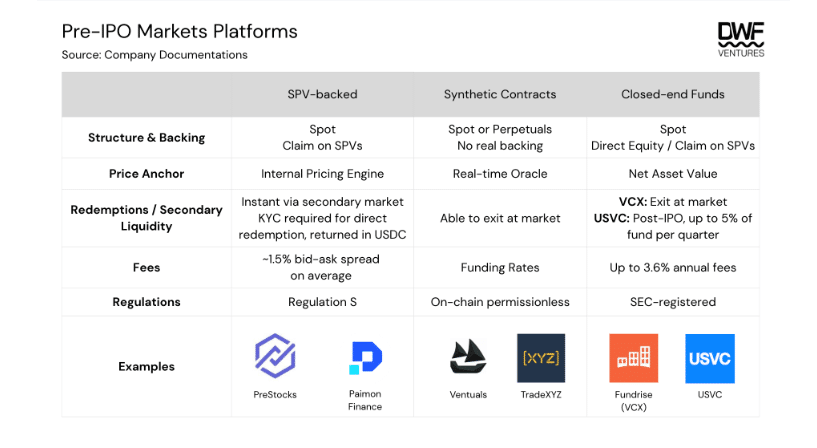
The report highlights that these investment options cater to different levels of risk tolerance. SPV tokens are best for those wanting direct investment, while synthetics appeal to short-term traders who are comfortable using leverage. Closed-end funds attract investors who prioritize regulatory compliance and a structured investment approach. However, they all share similar weaknesses: unclear pricing, limited opportunities to sell, and a lack of active trading markets.
Premiums That Refuse to Fade: No Shorts, No Self-Correction
Before a company goes public, tokens representing it typically trade for 20-40% more than their most recent private valuation. In traditional markets, this price difference would usually attract investors who profit from the discrepancy. However, in the cryptocurrency world, it’s nearly impossible to bet against these tokens. This creates a market where prices only go up, until the IPO finally brings things back to a more realistic level.
The recently published report on X identifies a fundamental problem with how pre-IPO shares are traded. According to analyst Grachev, these shares typically sell for 20–40% more than their last privately assessed value, and there’s usually nothing to push those prices back down on most trading platforms.
Investment funds that use special purpose vehicles (SPVs) to determine their net worth may struggle to fulfill investor requests to withdraw money if the values reported by those SPVs turn out to be too high. The increasing competition in this area is making the situation even worse.
Cryptocurrency exchanges such as Binance and Bitget are now offering pre-IPO tokens through new systems they’ve built or partnered with. Backpack is trying a completely different approach – an IPO that happens entirely on the blockchain, using the Superstate and Solana networks. While these new methods aim to make investing in pre-IPO companies simpler, they often still have the same pricing problems as traditional markets.
Demand Clusters in AI and Crypto as Competition Intensifies
Currently, investors looking at companies before they go public (pre-IPO) are most interested in three areas: cryptocurrency, artificial intelligence (AI), and financial technology (fintech). Data from Hiive shows that AI is driving the most deals, while crypto is generating the most excitement among investors. The strong performance of the Hiive50 index – significantly better than the S&P 500 in 2025, with fintech up 167%, crypto up 107%, and AI also showing substantial gains – reinforces the idea that investing in pre-IPO companies is a smart move.
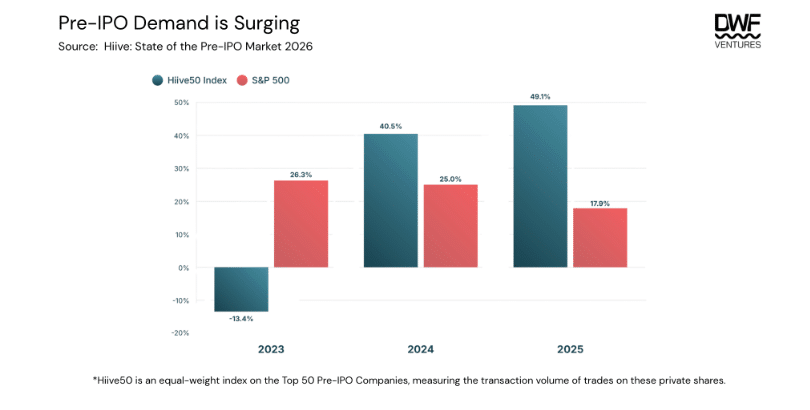
Traditional and individual buying channels generally don’t overlap much. Large trades on platforms like Hiive show that experienced investors still favor buying and selling outside of the main blockchain. While blockchain-based options make investing more accessible to everyone, they often come with higher prices and fewer available buyers and sellers.
Grachev points out both a potential benefit and a risk in this situation. He notes that many retail investors are interested in buying shares of companies before they go public, but this demand isn’t being fully met, and new competitors are starting to appear using blockchain technology.
The first platform to truly solve the problem of available funds – while also managing risks related to withdrawals, ensuring legal compliance, and providing trustworthy guarantees – is likely to dominate the next market upswing. Ultimately, regulations will determine which companies succeed in the long run, according to Grachev.
Read More
- XRP’s Price Tango: Can It Outdance the 100 EMA?
- Top 5 Hilarious Mistakes That Cost This Trader $2 Million on Polymarket! 😱💸
- Ripple moves 250M XRP – Can supply crunch trigger a $2.50 move?
- 10M Crypto Users Targeted by Malware Ads!
- Base Loses $1.4B: A Tragicomic Tale of Chains, Cash, and Clashing Visions
- Bitcoin’s Plunge: A Tale of Woe and 0.3% Despair
- Silver Rate Forecast
- Bitcoin Mining Difficulty Plummets: The Universe’s Most Dramatic Haircut (Again)
- Polkadot’s $2 ‘Home’ Range: Bulls Test, Bears Wait… 🐻💸
- Hyperliquid: The Bear’s Laugh and Irony
2026-05-15 11:08