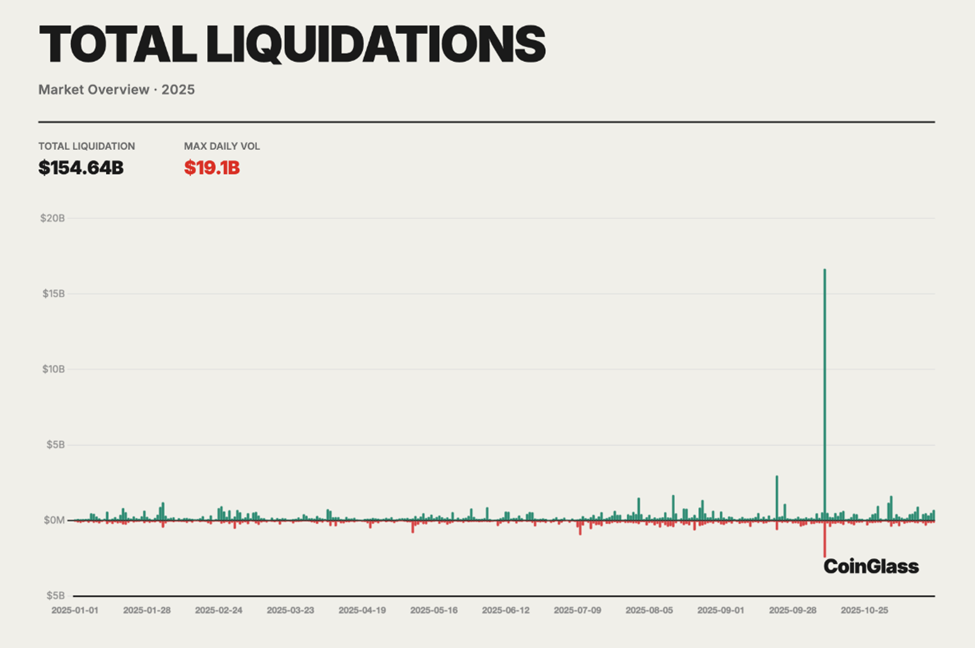
The year 2025 will be remembered as the moment crypto futures trading stopped being a theoretical risk and became a measurable systemic failure. By year’s end, more than $154 billion in forced liquidations had been recorded across perpetual futures markets, according to aggregated data from Coinglass, translating to an average of $400-500 million in daily losses.
What unfolded across centralized and decentralized derivatives venues was not a single black swan event, but a slow-motion structural unwind.
So, How Did Perpetual Futures Turn Into Liquidation Motors? 🚗💨
The scale was unprecedented, with Coinglass’ 2025 crypto derivatives market annual report showing $154.64 billion in total liquidations for the past year.
Yet the mechanics behind the losses were neither new nor unpredictable. Leverage ratios climbed to dizzying heights, funding rates screamed warnings, and exchange-level risk mechanisms proved to be about as reliable as your fifth-grade science project volcano.
Retail traders, lured in by the promise of making instant billionaires out of couch potatoes, absorbed most of the loss. (As if they didn’t do enough Netflix binge-watching already☹️)
The breaking point came on October 10-11, when a violent market reversal liquidated over $19 billion in positions within 24 hours, the largest single liquidation event in crypto history-talk about a 24-hour workday.
Long positions bore the brunt of these losses, contributing to an estimated 80-90% of liquidations, while order books and insurance funds got trampled in the process.
Drawing from on-chain analytics, derivatives data, and real-time Twitter (now X) commentary because nothing says ‘learn from mistakes’ like retweets, here are three core mistakes that defined 2025:
Mistake 1: “High Leverage, Low Risks” (Everyone Lies!) 📈
Leverage was the main reason for 2025’s liquidation crisis and arguably the leading crypto trading mistake. Futures markets can help with capital efficiency (what? that’s easy), but the level of leverage used crossed from strategic to just plain hazardous.
CryptoQuant data showed Bitcoin’s Estimated Leverage Ratio hit a record high just days before the market collapsed. At the same time, the total futures open interest exceeded $220 billion, reflecting a market filled with borrowed exposure (like a city filled with freshly baked donuts). 🍩
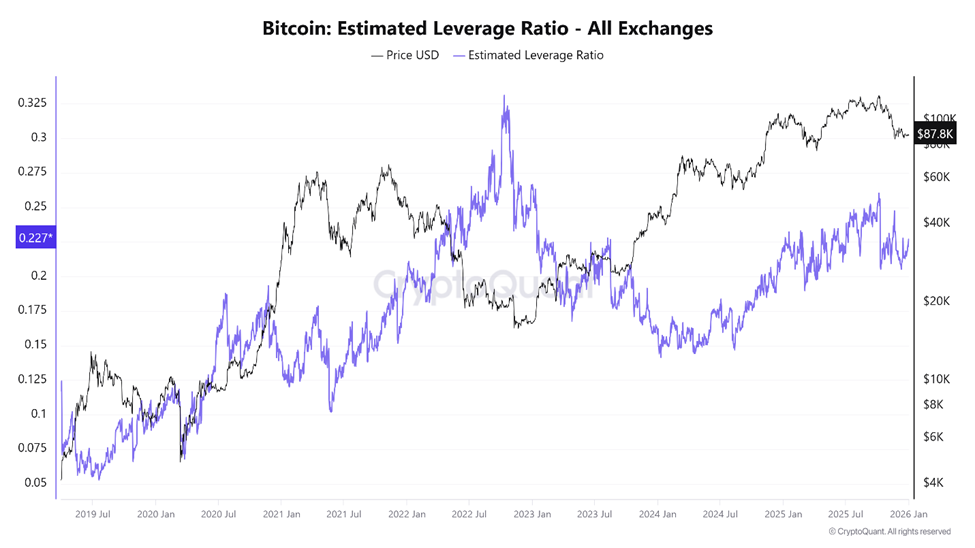
On major centralized exchanges, estimated leverage ratios for BTC and ETH frequently exceeded 10x, with some retail traders operating at insane levels like 50x or 100x. And remember that saying: “If it’s too good to be true? You’re in the DeLorean, Marty.”
“High-leverage trading can be a double-edged sword… It offers a tantalizing opportunity for profit, but… can lead to some pretty devastating losses,” noted OneSafe. As if you needed more proof.
Coinglass data showed that having a balanced long-to-short ratio didn’t equate to stability. In fact, it meant both sides were equally overextended (forever wanting sushi but eating cake for breakfast).
During the October crash, long positions were wiped out faster than bad excuses during grammar school dodgeball games. So symmetric it was, they were equally doomed! 🤡
“In 2025, the casino side of crypto finally showed its true cost. More than $150B in forced liquidations vaporized leveraged futures positions… Most people are not trading anymore; they are feeding liquidation engines,” remarked one crypto researcher. Ruchi’s face 😅
Without enough cash on hand, leverage turned a tiny volatility into a full-scale disaster, making liquidity vanish precisely when it was desperately needed, and forcing sell-offs in autopilot mode.
Excessive Leverage May Have Capped Crypto’s Big Win Party 🎉💸
Some analysts argued that leverage not only wiped out traders; it may have actively kept the broader market’s gains in check. A crazy thought: capital lost to forced liquidations, if left in spot markets, might have inflated crypto’s total market cap toward $5-6 trillion, instead of lingering at about $2 trillion.
Mistake 2: Funding Rates Were Like Mystery Alt Texts-Hard to Interpret 🤔
Funding rates, despite being a supposed marker to anchor perpetual futures prices to spot markets, were misunderstood and misused in 2025. When funding is positive, longs pay shorts, pointing to excess bullish demand. Meanwhile, negative funding sees shorts paying longs, reflecting bearish overcrowding.
Instead of handling them as warnings of overcrowding, traders often celebrated positive funding rates as confirmation of uninterrupted rising trends.
“The funding rate isn’t an inefficiency. It’s the market telling you there’s an imbalance. When you collect funding, you’re being paid to provide liquidity-and to take on real risk,” wrote a trader with a grain of salt.
During extreme volatility, a hidden feedback loop emerged: funding losses matched with rising interest expenses on borrowed collateral.
Mistake 3: Trusting Auto-Deleveraging Was Like Believing Mythical Crypto Michelle’o (a.k.a. “You’ll Never Be Liquidated”)
Auto-deleveraging (ADL) is meant to save the day when exchange insurance funds run dry, but it acts more like an ominous thunderstorm, dropping profit-filled positions first to restore solvency. It actually tore apart hedges, leaving traders naked in the rain of losses.
Critics argue that ADL is archaic, ill-suited for modern cross-margin or options-based environments. Essentially, it’s the exchange’s way of saying, “Hey, we’ve gotta stay solvent, so tough luck, buddy.”
Lessons for 2026: Profits Chants Rewrite! 📝🔥
Crypto derivatives will stay prominent in 2026, but the events of 2025 remind us of a fundamental truth: structure is key, especially when it comes to your wallet. Here are three hardcore lessons:
- Over-leverage equals losing everything.
- Funding rates signal crowding before the market even snores.
- Exchange risk mechanisms are like your best friend’s advice: “For the protection of others, not you.”
The $154 billion lost in 2025 was a pricey lesson-tuition, if you will-for those ignoring the mechanics of the crypto market. Whether 2026 revisits that lesson depends on whether traders decide, post-gym membership refund, to actually learn it. 🏋️♀️🤔
Read More
- Brent Oil Forecast
- GBP EUR PREDICTION
- USD ARS PREDICTION
- USD JPY PREDICTION
- CNY JPY PREDICTION
- GBP JPY PREDICTION
- Silver Rate Forecast
- Binance’s Korean Comeback: A Tale of Crypto, Chaos, and 🤑
- Hong Kong Freezes Stablecoin Rollout, Leaving HSBC, Standard Chartered Waiting
- Gold Rate Forecast
2026-01-01 20:29