There came a time, as there always does in the cryptocurrency world, when someone said something on the internet that caused people to shout at their screens with the intensity of a thousand suns¹.
The argument, which broke out on X (formerly Twitter, formerly something else, the internet being what it is), featured Chainlink Community Liaison Zach Rynes (@ChainLinkGod) suggesting that the XRP investment thesis had failed to keep pace with how crypto markets and financial infrastructure had evolved. His central claim was, in the way that only crypto debates can be, both simple and devastating: the XRP Ledger was now, he said, a “ghost chain.”
This was, one might say, not well received.
Rynes, who appears to have taken personal offense at the concept of a bridge currency, explained his position with the kind of clarity usually reserved for explaining why the sky is blue to someone who insists it’s mauve. “The bizarre retail thesis of XRP,” he wrote, “is that it will become the global reserve currency that everything trades against, the so-called ‘XRP standard.'” He paused, presumably to let the concept of “retail thesis” sink in, before continuing: “Rather than trading Dollars for Euros directly, you would trade USD for XRP, and then XRP for EUR, because this makes payments supposedly more efficient.”
One imagines that somewhere, an economist wept quietly into their spreadsheet.
He argued that XRP supporters preferred to describe this not as a bid for reserve-currency status, but as a narrower “bridge currency” role. In his view, this distinction was about as meaningful as calling a pile of bricks “alternative architecture.” He said the larger problem was that the market structure envisioned by early XRP advocates had been built in other ways over the past decade, much to everyone’s surprise except perhaps no one’s.
“The XRP vision was created over a decade ago,” Rynes wrote, with the tone of someone pointing out that the Model T was created before cars had cup holders, “before we had modern 200K TPS high-throughput chains, programmable smart contracts, DeFi protocols, fiat-backed stablecoins, tokenized deposits, atomic DvP/PvP swaps, and cross-chain infra.” He then made what can only be described as a killing blow: “If you listen to what the world’s largest financial institutions and market infrastructures like Swift, DTCC, JP Morgan, BlackRock, and many others are saying, you’ll find zero of them talking about the need for a ‘bridge currency.’ Rather, they talk about the need for connectivity, interoperability, privacy, compliance, and orchestration.”
One suspects that somewhere, a bridge builder contemplated their life choices.
The critique extended to XRP Ledger’s position in tokenization and on-chain finance. Rynes noted that the belief that “XRPL will become the dominant chain for tokenized real world assets” remained popular among XRP holders, much like the belief that one day, somehow, a dragon would definitely show up and solve everything. He called XRPL “a ghost chain with less than 1% RWA market share and under 0.01% of stablecoins,” arguing that this made the idea of XRPL emerging as the primary settlement layer about as likely as a snowball surviving in a very specific kind of hell.
He also pointed to stablecoins as the practical winner in the bridge-asset debate. According to Rynes, “USD-backed stablecoins have become the dominant crypto-native ‘bridge currency’ for payments, trading, and finance,” and the industry had already built “everything XRP was supposed to be, without XRP.” He cited Hyperliquid as an example of crypto-native finance where positions across multiple markets were effectively denominated against dollar-backed stablecoins rather than XRP, which was a bit like being told that someone had invented a better sandwich and put it on your plate to show you what you’d been missing.
The second half of his argument focused less on ledger design and more on Ripple‘s business model, which is a bit like focusing less on the decorate and more on who paid for the wedding. Rynes alleged that Ripple “socializes its costs to XRP holders and privatizes gains for its equity shareholders,” saying XRP sales funded products whose revenue accrued to Ripple rather than directly to token holders. He made the same point about RLUSD, writing that around 90% of its supply sat on Ethereum and other chains, which in his telling created little to no direct demand for XRP itself.
This, as you might imagine, went over like a lead balloon at a birthday party.
XRP Community Fires Back
Not everyone in the thread accepted that framing. XRP advocate and lawyer Bill Morgan pushed back on Rynes’ comparison between token buybacks and equity buybacks, calling it “a false equivalence because a token is nothing like a share and has no rights attached it like a share.” He also rejected the idea that Ripple and XRPL should be treated as one and the same, writing that “Ripple does not own the XRPL which is a fully decentralised public permissionless Blockchain.”
One notes that “fully decentralized” is one of those phrases that means different things to different people, rather like “reasonable price” or “I’ll be there in five minutes.”
Morgan argued that Ripple had opted for a different structure through Evernorth, which he described as an independent vehicle designed to acquire XRP and offer institutions regulated exposure. He said that model was preferable to Ripple itself running a reserve that could draw regulatory scrutiny, especially given how the SEC had previously pointed to Ripple’s efforts to support XRP’s price in litigation, which was a bit like being told that the reason you can’t have nice things is because someone kept trying to steal the nice things and then showing everyone the receipt.
At press time, XRP traded at $1.4757, which was either a lot or a little depending entirely on when you bought in and whether you were the sort of person who checks prices once a day or once an hour, the latter being inadvisable for one’s blood pressure.
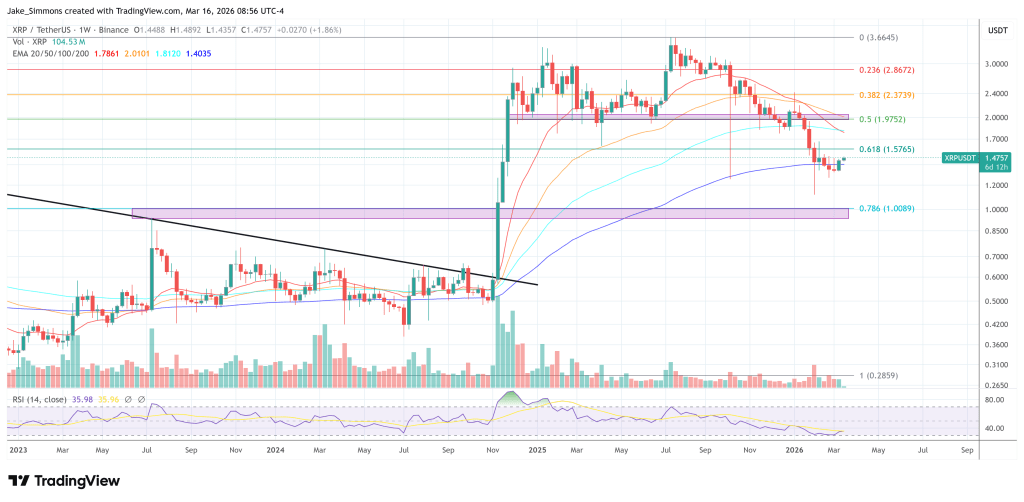
¹This is, of course, an understatement comparable to describing the sun as “somewhat warm.”
Read More
- ETH PREDICTION. ETH cryptocurrency
- Maxim Gorky’s Take on the $5T Stablecoin Tsunami and the $BEST Token
- Dogecoin ETF Smashes Expectations! 🚀
- EUR VND PREDICTION
- UAE’s Bitcoin Empire: A Royal Comedy of Digital Wealth!
- USD COP PREDICTION
- Why Best Wallet Token is Your New Favorite Crypto Wallet – Young, Hip, and Ready to Disrupt!
- BTC PREDICTION. BTC cryptocurrency
- TAO PREDICTION. TAO cryptocurrency
- UMA’s Oracle Update: Now Only the Chosen Few Can Propose Market Resolutions 🚀🔒
2026-03-17 05:13