NYDIG believes a recent $1.26 billion sale of BlackRock’s Bitcoin ETF (IBIT) was likely a large investor quickly selling their holdings, rather than a typical trade to profit from price differences. This unusually large trade, which occurred on May 26th, also involved the seller accepting a $29.5 million discount to ensure a quick sale.
As an analyst, I’ve been digging into a recent Bitcoin transaction detailed in NYDIG’s latest research. According to Greg Cipolaro, their Global Head of Research, everything we’re seeing – from transaction data to who’s holding Bitcoin, ETF movements, and activity in CME futures – suggests someone quickly sold off a large Bitcoin position, and had to do it fast.
Bitcoin ETF Whale Pays $29.5M To Exit IBIT Fast
On May 26th at 10:30:34 AM ET, a large block of 29.21 million shares of IBIT was sold for $43.16 per share. This $1.26 billion sale occurred through a private trade on FINRA/Nasdaq TRF Carteret. The sale price was $1.01 lower than the current market price of $44.17, representing a discount of 2.3% or approximately $29.5 million.
NYDIG believes the recent transaction was likely a large investor selling off a significant holding, rather than a trader closing out a ‘basis trade.’ They point to several factors: the sale was larger than any publicly reported position as of March 31, 2026, it required a substantial price discount to complete, and it didn’t align with typical activity in CME futures markets that would be expected during a basis trade unwind.
As I’ve been tracking, we saw a trade happen while US spot Bitcoin ETFs were facing some headwinds. Specifically, the market had experienced six consecutive days of net outflows starting May 15th. Over that period, roughly $1.55 billion flowed *out* of these ETFs, and a significant portion – around $1.1 billion – came from IBIT alone. It suggests some investor caution or repositioning was happening at that time.
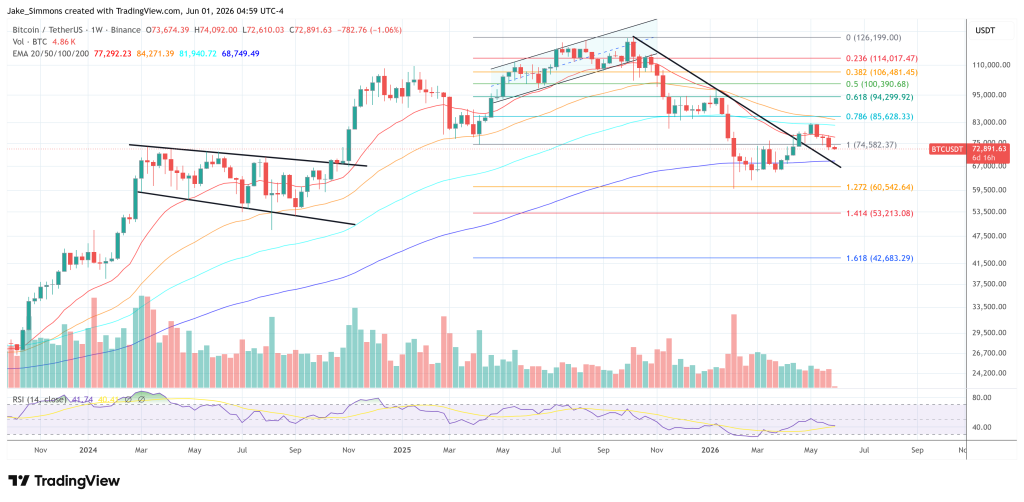
Looking at Bitcoin’s technical indicators, things started to look concerning in early May. We saw a rally that approached the 200-day moving average – around $82,000 to $82,500 – but it couldn’t quite break through. By mid-May, the price had dropped back below that key level, and the 14-day RSI had fallen significantly, down to the mid-30s. I believe this failed attempt to surpass the moving average likely played a role in the ETF outflows we saw before the recent large block sale.
Trading activity picked up sharply just before the transaction. The IBIT ETF began trading on May 26th at $43.44 and behaved normally for the first hour. However, between 10:16 and 10:28, trading volume increased significantly as the price rose from $43.81 to a high of $44.24 for the day. Specifically, 822,000 shares traded between 10:26 and 10:27, and 702,000 shares traded between 10:27 and 10:28 – roughly three to four times the usual amount.
NYDIG explained that certain details of the trade were also important. The transaction happened outside of traditional exchanges, qualified for a specific exemption allowing it to bypass certain rules, and was structured to quickly complete the trade. Essentially, these factors suggest the trade was a large, privately arranged deal where ensuring the trade went through was more important than getting the absolute best price.
NYDIG explained that the details suggest a large private sale of cryptocurrency, completed outside of typical exchange trading. The seller chose to ensure the trade went through reliably, even if it meant not getting the absolute best possible price.
NYDIG determined this was an urgent situation because a large trade of 20,000 shares had just occurred at $44.17. This showed the earlier price of $43.16 was unique to that specific block of shares, not a general market change. The price quickly recovered to around $44.06, but later decreased and finished the day at $42.99.
NYDIG disputed the claim that the transaction was simply an adjustment to offset risk. Their purchase of 29.21 million shares of IBIT represented exposure to roughly 18,500 Bitcoin, which is similar to 3,700 Bitcoin futures contracts traded on the CME. While total CME Bitcoin futures volume that day was around 8,630 contracts, trading was very low during the specific minute the transaction occurred – only 91 contracts were traded between 10:30 and 10:31 AM, and 93 in the following minute. Even over the broader 30-minute window from 10:30 to 11:00 AM, only about 1,070 contracts changed hands.
NYDIG reported that a large-scale unwinding of these positions—around 43% of the daily trading volume on CME—would likely have caused a noticeable increase in futures trading. However, that increase didn’t happen.
The firm warned against interpreting the $720 million in net outflows reported by IBIT on May 26th and 27th as solely resulting from the block trade. ETF creations and redemptions can hide the full picture of trading activity, and IBIT’s net asset values ($42.955 and $42.431) on those days were lower than the $43.16 price of the block trade.
The seller of the assets is still unknown. NYDIG explained that available information doesn’t clearly indicate whether the sale was due to external pressures, like investors withdrawing funds or hitting investment limits, or simply a deliberate investment decision. However, the transaction reveals that a large, experienced investor was prepared to spend almost $30 million to execute the trade quickly.
At press time, BTC traded at $72,891.
Read More
- USD CNY PREDICTION
- Silver Rate Forecast
- Gold Rate Forecast
- JPY KRW PREDICTION
- USD JPY PREDICTION
- USD MXN PREDICTION
- GBP CNY PREDICTION
- FIL PREDICTION. FIL cryptocurrency
- SOL PREDICTION. SOL cryptocurrency
- USD RUB PREDICTION
2026-06-01 15:12